
How Much Does a Website Redesign Cost in 2026? (Full Breakdown)
You searched for website redesign costs and got answers ranging from $500 to $500,000. That range is not helpful. It is almost deliberately vague.
The truth is that the price difference between a $3,000 freelancer project and a $75,000 agency engagement is not about quality alone. It is about scope, platform complexity, content needs, and whether you are solving the right problem in the first place.
This breakdown will give you actual numbers, explain what drives them, and introduce a simple framework to figure out which tier of investment actually makes sense for your business right now.
Why Website Redesign Costs Vary So Wildly (And What That Means for You)
Most people assume price variance is just agencies padding margins. It is not.
A five-page portfolio site for a freelance photographer and a 200-page e-commerce platform for a mid-size retailer are both called “websites.” Asking what either one costs to redesign is like asking what a car costs. The question needs context before it has an answer.
The Three Variables That Drive Every Redesign Quote
Every redesign quote, regardless of who gives it, is built on three core variables:
Scope — How many pages, what features, and how custom the design needs to be.
Platform — Whether you are staying on your current CMS, migrating to something new like Webflow or Shopify, or building something fully custom.
Content — Whether you already have copy, photography, and video ready to go, or whether those need to be created from scratch.
Change any one of those three, and the price changes significantly. Change all three, and you can move between tiers entirely.
Why “It Depends” Is the Most Honest Answer (And What to Do About It)
Every agency that says “it depends” without explaining what it depends on is not being helpful. But the honest version of that answer is this: a redesign quote is not a product price. It is a project estimate. And estimates require scope.
Before you talk to any vendor, know your page count, your platform preference, and whether you are bringing content or buying it. Those three answers will cut your quote range by at least half.
Website Redesign Cost in 2026: A Tier-by-Tier Breakdown
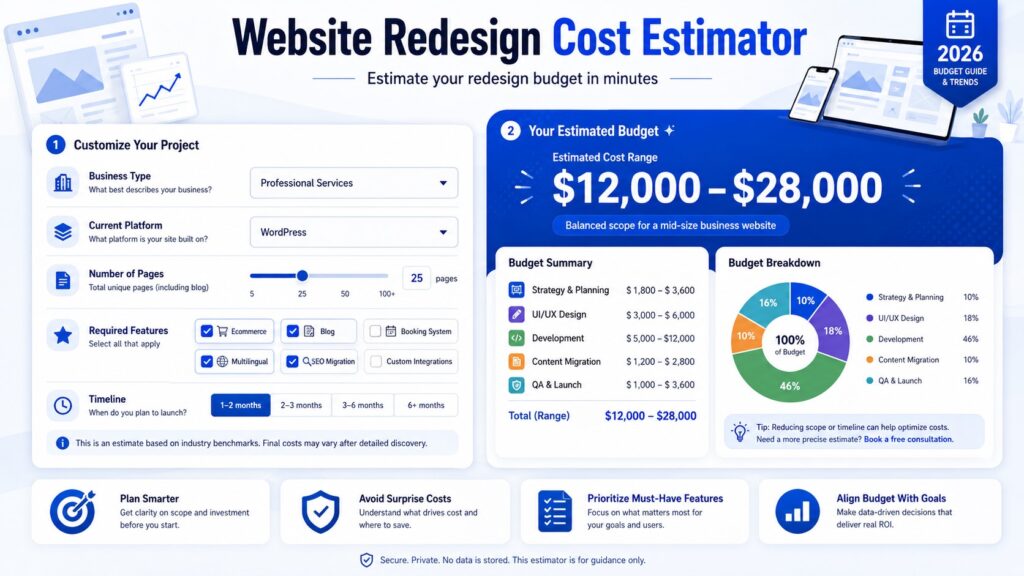
Website redesign costs in 2026 range from $500 for a DIY template build to over $100,000 for a full agency-led project, depending on scope, platform, and features.
Here is how the tiers break down:
| Tier | Typical Cost Range | Best For | Typical Timeline |
|---|---|---|---|
| DIY / Template | $500 – $3,000 | Solopreneurs, early-stage startups | 2–6 weeks |
| Freelancer-Led | $3,000 – $15,000 | Small businesses, service providers | 4–10 weeks |
| Agency (Mid-Tier) | $15,000 – $50,000 | Growing SMBs, lead-gen focused sites | 8–16 weeks |
| Agency (Full-Service) | $50,000 – $100,000+ | Enterprise, complex e-commerce | 4–6 months |
| Custom / Enterprise | Quoted per project | High-volume platforms, SaaS products | 6–12 months |
DIY and Template-Based Redesigns ($500 to $3,000)
Platforms like Squarespace, Wix, and WordPress with premium themes fall into this range. You are paying for hosting, a theme license, and maybe a few plugins.
The tradeoff is time and ceiling. You will spend 40 to 80 hours doing what a developer does in 10. And you will hit limitations fast once you need custom functionality.
This tier makes sense if you are pre-revenue, testing a concept, or running a simple brochure site with no complex integrations.
Freelancer-Led Redesigns ($3,000 to $15,000)
A skilled freelancer, particularly one who specializes in WordPress or Webflow, can deliver a solid, well-designed site in this range. You get more customization than a DIY build and a faster turnaround than most agencies.
The risk is single-point dependency. If your freelancer goes dark mid-project, or moves on after launch, you are on your own for support. Vet them on past client retention, not just portfolio aesthetics.
Agency Redesigns ($15,000 to $100,000+)
This is where you get a team: strategist, designer, developer, project manager, and often an SEO specialist. The process is more structured, discovery is deeper, and the output is typically more aligned with business goals.
The premium is real. But so is the value, when the scope justifies it.
For a business generating $500,000 or more annually, a $25,000 redesign that improves conversion rate by even 0.5% pays for itself quickly. The math matters more than the sticker price.
Enterprise and Custom Builds (Custom Pricing)
At this level, you are not buying a website. You are buying a platform. Custom integrations, proprietary CMS builds, multi-region deployments, and performance at scale all require bespoke scoping.
Omayik Digital handles projects in this range on a discovery-first basis. No ballpark numbers until we understand the actual architecture requirements.
What Actually Drives the Cost Up (The Real Line Items)
The tier table gives you ranges. This section tells you what pushes you toward the top of each range.
Site Size and Page Count
Most quotes are roughly linear by page count up to a point, then they are not. The first 10 pages carry the heaviest design overhead: global templates, component libraries, style guides. Pages 11 to 50 are cheaper per page. Beyond 50, complexity compounds again.
A 5-page site and a 50-page site are not 10x different in cost. But a 50-page site and a 200-page site often are.
Platform and CMS Choice (WordPress, Webflow, Shopify, Custom)
Staying on your current platform is cheapest. Migrating is not just a technical task. It involves content mapping, URL restructuring, redirect planning, and QA across every page.
WordPress migrations to Webflow, for example, often add $3,000 to $8,000 to a project budget when done properly. Shopify migrations from custom platforms can add considerably more, depending on product catalog size and third-party integrations.
Custom Features and Integrations
A contact form is cheap. A custom booking system with calendar sync, payment processing, and automated email flows is not.
Every custom feature is its own mini-project. Before you add one to your scope, ask whether an existing plugin or third-party tool could do 80% of the job at 20% of the cost.
Content: Copywriting, Photography, and Video
This is the most underestimated line item in almost every redesign budget.
Copywriting for a 20-page site typically runs $3,000 to $8,000 from a skilled writer with SEO experience. Brand photography adds $1,500 to $5,000. Video production varies enormously but rarely comes in under $2,000 for anything professional.
If you come to a redesign with all content ready and approved, you will save time, money, and friction. Most clients are not there. Budget accordingly.
SEO Migration, Redirects, and Technical Audit
This is where Core Web Vitals, redirect mapping, and technical SEO intersect with your redesign timeline.
A proper SEO migration for a 100-page site involves auditing existing rankings, mapping every old URL to a new destination, implementing 301 redirects, updating internal links, and resubmitting sitemaps. Done well, it takes 15 to 25 hours. Skipped entirely, it can cost you 30 to 60% of your organic traffic in the months after launch.
The Hidden Costs Nobody Puts in the Proposal
The proposal covers what was agreed. What it often does not cover is what comes next.
Post-Launch Maintenance and Hosting
Most websites need ongoing maintenance: plugin updates, security patches, uptime monitoring, and occasional content edits. Budget $100 to $500 per month for a managed WordPress site, or $50 to $200 for a Webflow or Squarespace site with fewer moving parts.
Hosting ranges from $20/month for shared hosting to $300+/month for managed cloud hosting on WP Engine or Kinsta if you need performance guarantees.
Third-Party Tools, Licenses, and Plugins
Premium plugins, form builders, chat tools, CRM integrations, heat mapping software, and SEO platforms all have annual fees. A typical small business website runs $500 to $2,000 per year in third-party tool costs that nobody thinks to budget for at the redesign stage.
Scope Creep and Change Orders
The single most common cause of budget overruns is not vendor pricing. It is undefined scope.
“Can we add a blog?” mid-project is a change order. “Actually, can we make this section interactive?” is a change order. “Let us also redo the client portal while we’re at it” is a project within a project.
Scope creep on agency projects averages 20 to 35% over original budget when not managed with a formal change order process. Ask your vendor how they handle it before you sign anything.
Training and Internal Handoff Costs
Someone on your team needs to know how to update the site after launch. Factor in 2 to 4 hours of CMS training, documentation time, and at least one round of internal Q&A. Agencies often include this, but freelancers frequently do not.
Freelancer, Agency, or DIY? Choosing the Right Fit for Your Budget
This is not purely a budget decision. It is also a risk and complexity decision.
When a Freelancer Is the Right Call
A freelancer makes sense when your project is well-defined, your timeline is flexible, your budget is under $15,000, and you do not need ongoing strategic support after launch.
The key is specificity. The more clearly you can define scope before you engage a freelancer, the lower your risk.
When an Agency Is Worth the Premium
An agency earns its premium when you need strategic alignment between design, development, SEO, and content. Or when the project is large enough that managing multiple specialists yourself would consume more time than the cost difference.
Agencies also bring process. Defined phases, documented decisions, handoff protocols. That structure has value when a project involves multiple stakeholders or sensitive deadlines.
When DIY Is Genuinely a Good Option (And When It Backfires)
DIY works when the site is genuinely simple and the business does not depend on it for lead generation or revenue. It backfires when business owners underestimate the time cost, overestimate their design instincts, or try to build features that require real development skill.
A bad DIY website that stays broken for 18 months while the owner figures it out costs far more in lost opportunity than a $5,000 freelancer project would have.
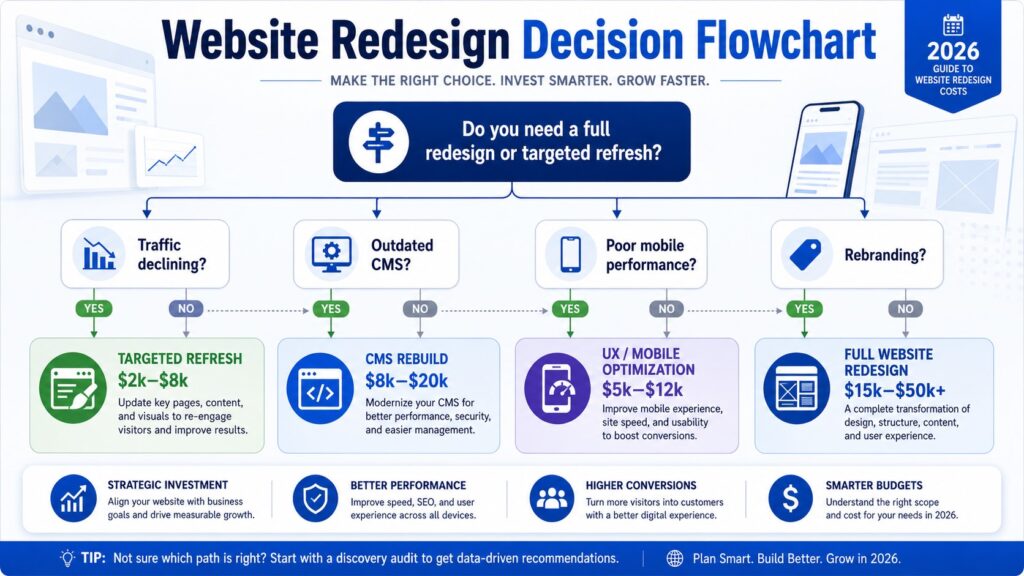
How to Know If Your Website Actually Needs a Full Redesign
This is the question most articles skip. Not every business needs a full redesign. Some need targeted fixes. Some need nothing at all, just better content.
The Redesign Readiness Score: A Quick Self-Assessment
Run through these five signals. If three or more apply, a full redesign is likely justified:
- Your site is over 4 years old and has never had a major update
- Mobile traffic accounts for over 50% of visits, and the mobile experience is poor
- Core Web Vitals scores are consistently in the red on Google PageSpeed Insights
- Your conversion rate has been flat or declining for 12+ months without another explanation
- Your brand has evolved significantly and the site no longer reflects who you are
If only one or two apply, a targeted UX audit and selective improvements may be a better use of budget.
Signs You Need a Full Redesign vs. a Targeted Refresh
| Signal | Recommended Approach |
|---|---|
| Outdated CMS or platform (e.g., old WordPress, Flash-based) | Full Redesign |
| Poor mobile performance only | Responsive Design Update |
| Low conversion rate with good traffic | CRO Audit + Landing Page Optimization |
| Brand overhaul or company pivot | Full Redesign |
| Slow load times only | Performance Optimization |
| Full content and navigation overhaul needed | Full Redesign |
Questions to Ask Before You Sign Anything
Before engaging any vendor, get clear answers to these:
What is included in your discovery phase? What is explicitly excluded from scope? How do you handle change orders? Who owns the site files at the end of the project? What does post-launch support look like?
How to Get the Most Out of Your Redesign Budget
A bigger budget does not guarantee a better outcome. Preparation does.
What to Prepare Before You Talk to Any Agency
Come to any vendor conversation with these ready:
A clear business goal for the redesign (more leads, better e-commerce conversion, brand repositioning). A rough page list. Existing brand assets (logo files, color codes, fonts). A realistic timeline. And a decision-making process — who has final approval, and how many revision rounds are expected.
Agencies price based on unknowns. The more unknowns you eliminate before the proposal stage, the more accurate (and often lower) your quote will be.
How to Evaluate a Proposal (Red Flags and Green Flags)
Red flags: Vague deliverables with no milestone breakdown. No mention of SEO migration. No defined revision rounds. No post-launch support plan.
Green flags: Discovery phase before design begins. Defined feedback loops. Technical SEO explicitly scoped. Clear intellectual property terms. References available on request.
How Omayik Digital Approaches Website Redesign Projects
At Omayik Digital, every redesign starts with a discovery engagement before any design work begins. We map your current site’s performance, identify SEO risks, define the content strategy, and establish measurable success criteria.
That discovery process means our proposals are specific, not templated. And it means clients know what they are getting before a single wireframe is drawn.
Quick Answers: Your Most Common Redesign Cost Questions
How much does a website redesign cost in 2026?
Website redesign costs in 2026 range from $500 (DIY) to $100,000+ (full-service agency), with most small business projects landing between $5,000 and $25,000.
The range is wide because scope varies enormously. A five-page service site costs a fraction of a 100-page e-commerce build. Platform, content, and custom features are the biggest cost drivers within each tier.
What factors affect the cost of a website redesign?
The five biggest factors are: page count and scope, platform choice (and whether migration is required), content creation needs, custom feature complexity, and SEO migration work.
Any one of these can move a project up or down an entire pricing tier. Businesses that come prepared with defined scope and ready-to-use content consistently see lower quotes and faster timelines.
Is it cheaper to redesign a website or build from scratch?
A redesign is typically cheaper when the existing CMS and structure are sound. A new build is more cost-effective when the codebase is outdated or migration complexity would exceed the cost of starting fresh.
The decision comes down to technical debt. A good agency will audit your existing site before recommending either path. Be cautious of vendors who push a full rebuild without reviewing what you have.
How long does a website redesign take?
Timelines vary by scope: small sites (under 10 pages) take 4 to 8 weeks; mid-size business sites take 8 to 16 weeks; large or complex builds take 4 to 6 months.
Client-side delays — slow feedback, missing content, stakeholder approval bottlenecks — are the most common reasons projects run over schedule. Having content and decision-makers ready before kickoff shortens timelines significantly.
Can a website redesign improve SEO rankings?
Yes, when done correctly. A redesign that improves Core Web Vitals, fixes crawl errors, and preserves URL structures with proper 301 redirects can meaningfully boost organic visibility.
Done poorly, the same redesign can cause 30 to 60% traffic drops in the months following launch. SEO migration planning is not optional. It should be a defined, scoped deliverable in any agency proposal.
Ready to figure out what your redesign actually needs? Omayik Digital offers a no-commitment discovery session to help you scope your project before you talk to anyone else. [Get in touch]
Leave a Reply