
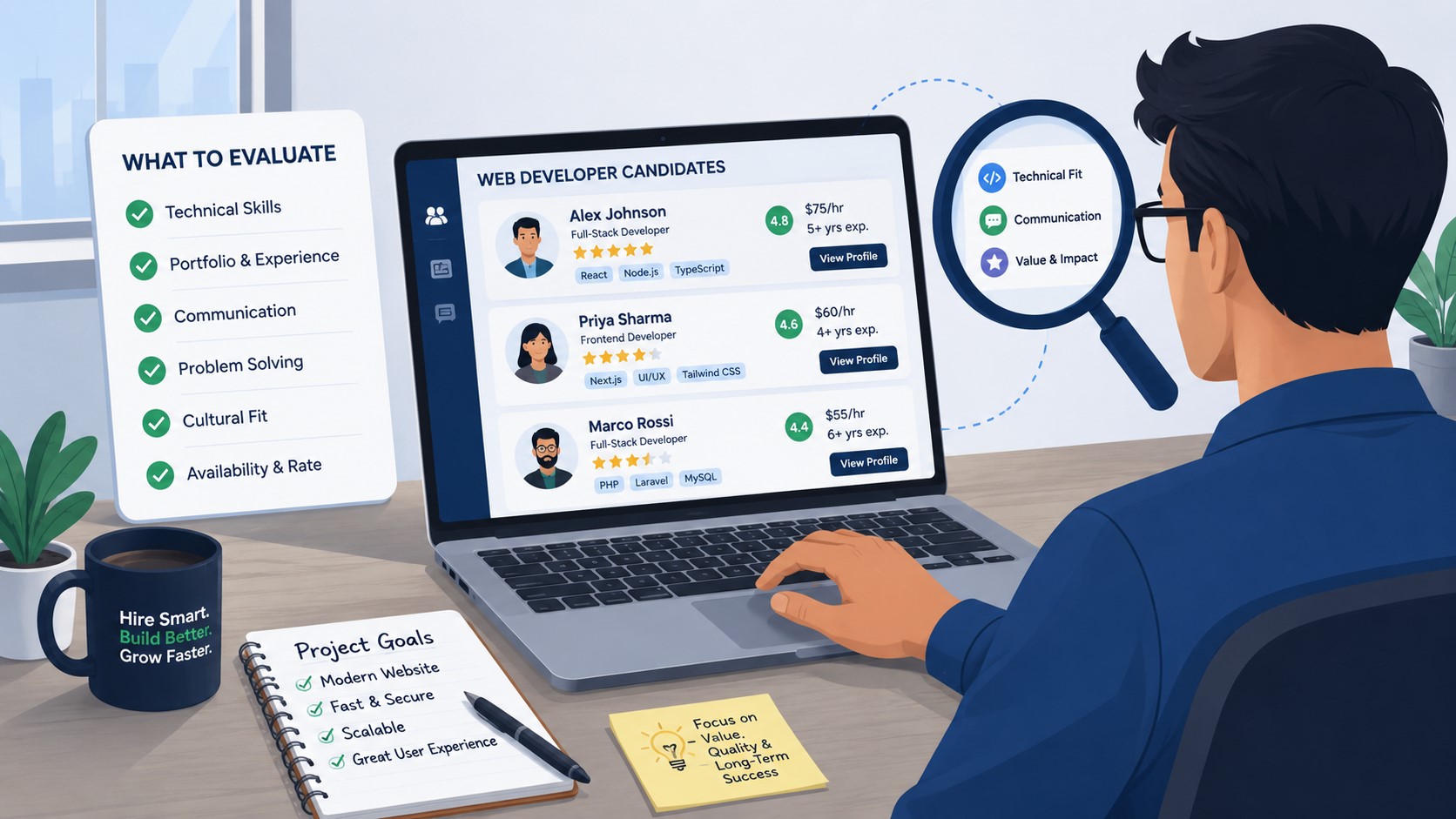
How to Hire a Web Developer in 2026: A Step-by-Step Guide
Hiring a web developer comes down to three decisions: who you hire, how you vet them, and what you put in writing before any work starts. Get those three right and the rest of the process takes care of itself. Get any one of them wrong and you end up with a half-finished site, a blown budget, or both.
This guide walks through the process in order: understanding your options, running a real vetting process, avoiding the mistakes that trip up most small business owners, and knowing what a fair contract and timeline actually look like in 2026.
Contact us: https://omayikdigital.com/contact-us/
Simple pricing: https://omayikdigital.com/pricing-plans/
Understand Your Options First
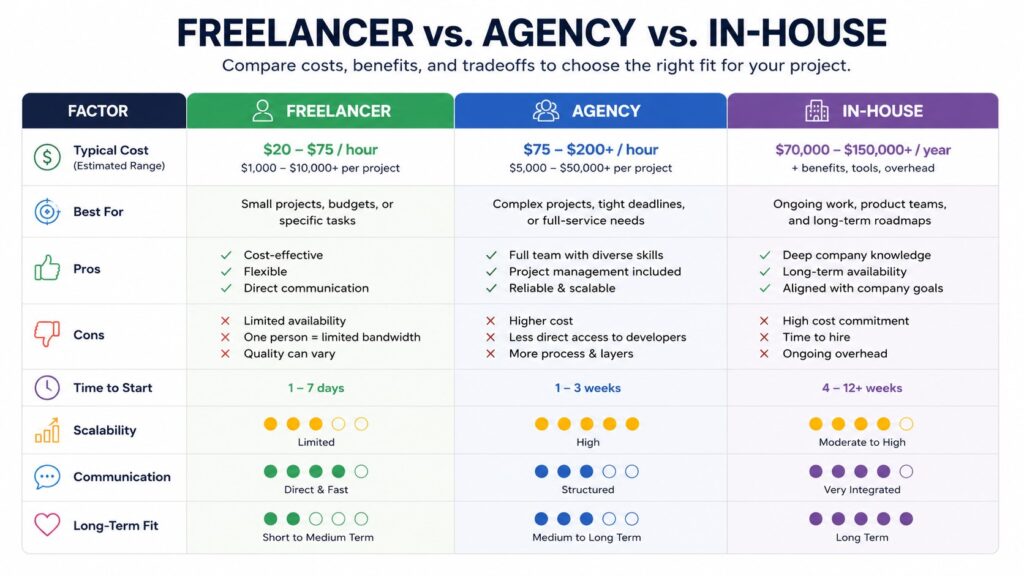
Before you post a job or start emailing agencies, it helps to know what you’re actually choosing between. Most small business owners default to whichever option a friend mentioned, without realizing there are real tradeoffs between them.
Freelancers work solo, usually through platforms like Upwork or through direct referrals. They tend to be the cheapest option and the most flexible for small, well-defined projects. The tradeoff is capacity and redundancy: if your freelancer gets sick, goes silent, or moves on to a bigger client, your project stalls with no backup.
Agencies bring a team, which means design, development, and project management are usually handled by different people rather than one person wearing every hat. This tends to produce more consistent quality and faster turnaround, but at a higher price point than a solo freelancer.
In-house hires make sense once you have enough ongoing web work to justify a full-time salary, benefits, and management overhead. For a single website build or redesign, this is almost always the most expensive and slowest path, since you’re recruiting for a permanent role rather than a project.
Here’s how the three compare on the factors that actually matter when you’re deciding:
| Factor | Freelancer | Agency | In-house Hire |
|---|---|---|---|
| Typical cost | Lowest upfront cost, but wide variance by skill level | Mid-to-high, usually fixed-scope pricing | Highest total cost (salary, benefits, tools, management time) |
| Speed | Depends entirely on one person’s availability | Often faster due to parallel work across a team | Slowest to start (recruiting takes weeks to months) |
| Quality control | Inconsistent; depends on the individual | Generally more consistent, backed by internal review processes | Consistent once ramped up, but ramp-up takes time |
| Best fit for | Small, simple sites or well-defined one-off tasks | Full builds, redesigns, or anyone who wants one point of contact | Companies with continuous web/product work, not a single project |
| Risk | Single point of failure if they become unavailable | Lower risk due to team redundancy | Low risk long-term, high risk if the hire doesn’t work out |
If you’re building or redesigning a full website and want a fixed price and a single point of contact, an agency is usually the more predictable choice. Omayik Digital, for example, structures projects around fixed pricing and a 7-day delivery window specifically so business owners aren’t left guessing about cost or timeline midway through.
The Step-by-Step Hiring Process
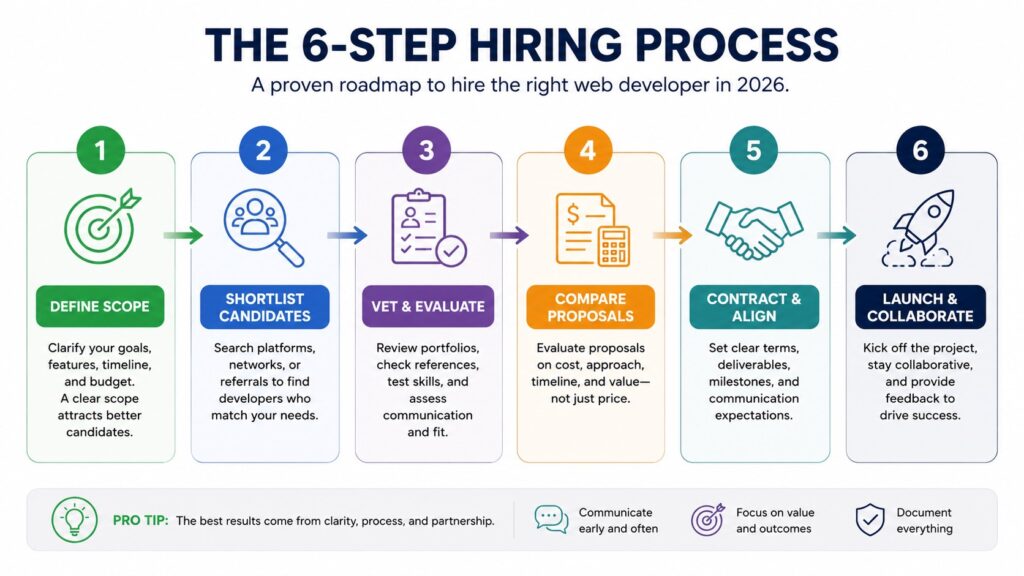
Once you know which lane you’re in, the actual hiring process follows a consistent sequence. Skipping steps here is where most bad hires happen.
Step 1: Define Your Scope Before You Talk to Anyone
Write down what the website needs to do before requesting quotes. At minimum, define:
- Number of pages and what each one needs to accomplish
- Must-have features (booking forms, e-commerce, membership login, chatbot, CRM integration)
- Design references (2–3 sites you like and why)
- Content status (do you have copy and images ready, or does that need to be created too)
- Your realistic budget range
Vague scope produces vague quotes, and vague quotes produce disputes later about what was actually included.
Step 2: Build a Shortlist of 3–5 Candidates
Look at portfolios first, but look past the visuals. Check whether the sites in a developer’s portfolio actually load fast, work well on mobile, and appear to still be live and maintained. A polished screenshot of a site that’s since gone offline or broken tells you less than it looks like it does. Omayik Digital’s portfolio is a reasonable example of what to check for: live, working sites rather than static mockups.
Step 3: Run a Real Vetting Conversation
This is the step most people rush. Use it to ask direct questions, not just “tell me about your experience.”
Questions to ask every candidate:
- What’s your process from kickoff to launch, and how long does each phase take?
- Who exactly will be working on my project (this matters more with agencies, where the person who sold you the project isn’t always the person who builds it)?
- What’s included in the price, and what counts as a change request that costs extra?
- What happens if I want changes after launch?
- Can I see a live site you built in the last six months, not just a portfolio image?
- What platform or approach do you recommend for my situation, and why?
The answers matter less than how directly they’re answered. Vague answers to direct questions are themselves a signal.
Step 4: Compare Proposals on More Than Price
The cheapest quote is rarely the cheapest outcome once you account for revisions, delays, and rework. Compare proposals on scope clarity, timeline realism, and whether post-launch support is included, not just the bottom-line number.
Step 5: Get Everything in a Written Contract
Before any deposit or work begins, confirm the contract includes:
- Full scope of work, in writing, matching what was verbally discussed
- Total price and payment schedule (deposit, milestones, final payment)
- Timeline with specific milestones, not just a final delivery date
- Who owns the code, design files, and domain/hosting credentials after completion
- What happens if either party wants to cancel mid-project
- What support, if any, is included after launch, and for how long
If a developer or agency resists putting any of this in writing, treat that as a red flag rather than a formality to skip.
Step 6: Launch and Confirm Handoff
Before calling the project done, confirm you actually have access to everything: domain registrar login, hosting account, CMS admin access, and any third-party accounts set up during the build (analytics, email marketing, CRM). It’s common for business owners to discover months later that they never actually had ownership of their own domain or hosting account.
Red Flags to Watch For
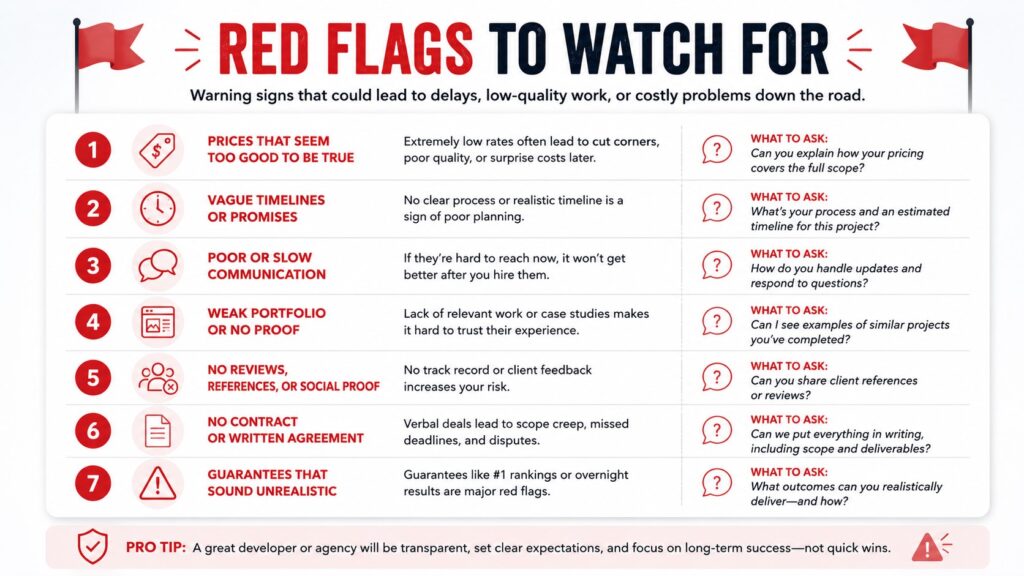
Some warning signs show up early enough to save you from a bad hire entirely.
- No written contract or scope document. Verbal agreements don’t hold up when a dispute happens.
- Vague or shifting pricing. If the quote changes significantly between the first conversation and the proposal without a scope change to explain it, ask why.
- No live examples of recent work. A portfolio full of mockups or years-old projects, with nothing current, is worth questioning.
- Pressure to decide immediately. Legitimate developers and agencies can handle you taking a day or two to compare options.
- Unrealistic timelines with no explanation. A promise of same-day or 24-hour delivery for a full custom site usually means either the site is a barely-modified template or corners are being cut somewhere you won’t see until later.
- No clarity on who owns what after launch. If domain, hosting, and code ownership aren’t addressed upfront, assume you’ll have to fight for it later.
- Communication that goes quiet mid-project. Ask how they handle updates during the build, and hold them to it.
None of these individually means walk away immediately, but two or more together is a strong signal to keep looking.
What Should a Website Actually Cost in 2026?
There’s no single honest answer to “how much should this cost,” because cost depends heavily on scope. What’s realistic is understanding the rough bands and what drives the difference between them.
- DIY builders (Wix, Squarespace, and similar) cost the least out of pocket but require your own time investment and come with real limits on customization and scalability.
- Freelancers vary enormously by skill level and location, and pricing is usually hourly or per small task, which makes total cost harder to predict upfront.
- Small agencies more often work on fixed-scope, fixed-price models for a defined project, which trades some flexibility for cost predictability.
- Full-service or larger agencies typically cost more but bundle in strategy, ongoing support, and a broader skill set (design, development, SEO, sometimes marketing automation) under one roof.
The variables that move the price most are the number of custom pages, whether you need custom functionality versus a template-based build, whether content and images need to be created from scratch, and whether ongoing support is bundled in or billed separately. Ask any candidate to break down what’s driving their number rather than accepting a flat quote without context. Some agencies, including Omayik Digital’s pricing plans, publish fixed packages upfront so you can compare cost bands before ever getting on a call.
How Long Should It Actually Take?
Realistic timelines vary by scope, but a small business website with a handful of pages typically takes anywhere from one to several weeks once content is ready, and longer if content still needs to be written or designed from scratch. Larger builds with custom functionality, e-commerce, or integrations naturally take longer.
Be skeptical of both extremes: a “same-day” promise for a full custom build usually means a barely-modified template, while a multi-month timeline for a straightforward brochure site with ready content suggests either poor process or overcommitment elsewhere. Ask what’s included in the estimated timeline and what could extend it, such as delayed content or slow revision turnaround on your end.
A Realistic Scenario
Say a small business owner is choosing between two candidates for a five-page website with a booking form. Candidate A quotes lower and promises delivery in five days, but can’t show a live site built in the last year and gives a vague answer when asked who owns the domain after launch. Candidate B quotes slightly higher, walks through a specific week-by-week process, and points to two live, working sites from the last few months.
On price alone, Candidate A looks better. Once ownership, timeline realism, and portfolio verification are factored in, Candidate B is the safer choice, because the higher quote comes with less risk of rework, disputes, or a stalled project. This is the kind of comparison the vetting checklist above is designed to surface before money changes hands, not after.
Frequently Asked Questions
How much does it cost to hire a web developer in 2026? Costs vary widely depending on scope, ranging from low-cost DIY builder plans to several thousand dollars for a custom agency build. Ask for a breakdown of what drives the price rather than comparing flat numbers across candidates.
How long does it take to build a website? A straightforward small business site typically takes anywhere from one to several weeks once content is ready. Custom functionality, e-commerce, or heavy content creation needs will extend that timeline.
Should I hire a freelancer or an agency? Freelancers work well for small, well-defined projects and tend to cost less. Agencies bring team redundancy, more consistent quality control, and are usually a better fit for full builds or redesigns where you want one point of contact.
What should be in a web development contract? A solid contract includes the full scope of work, total price and payment schedule, a milestone-based timeline, who owns the code and domain after completion, cancellation terms, and what post-launch support is included.
Do I need to know how to code to work with a developer? No. You need to be able to clearly describe what you want the site to do and give timely feedback during revisions. A good developer or agency will translate your goals into the technical build without requiring you to understand the code itself.
What happens after my website launches? This depends entirely on what’s in your contract. Some developers hand off everything at launch with no further support, while others include a defined support window. Omayik Digital, for instance, includes 30 days of post-launch support as part of its standard process. Confirm this detail before signing anything, regardless of who you hire.
Ready to Start the Process?
If you’d rather skip the vetting process entirely and work with a team that already builds around fixed pricing, clear timelines, and post-launch support, get in touch with Omayik Digital to talk through your project scope.
Contact us: https://omayikdigital.com/contact-us/
Simple pricing: https://omayikdigital.com/pricing-plans/

Leave a Reply