

How Much Does Web Development Cost in 2026? (Detailed Guide)
A basic business website in 2026 typically runs anywhere from $1,500 to $6,000. A more capable small business site with custom features can land between $6,000 and $15,000. E-commerce stores usually start around $8,000 and can climb past $30,000 depending on how much custom functionality you need. Custom web applications, the kind with logins, dashboards, or booking systems built from scratch, often start at $15,000 and go well into six figures for complex builds.
That’s the honest short answer. But if you’ve priced this out yourself, you already know the real problem: everyone gives you a range, and almost nobody tells you why the range is so wide or which end of it you’ll actually land on.
This guide breaks that down. We’ll walk through what drives web development costs up or down, what it actually costs to keep a site running after launch, which hidden expenses catch people off guard, and how to tell whether a quote you’ve received is fair. By the end, you should be able to put a real number next to your own project instead of guessing.
Contact Us: https://omayikdigital.com/contact-us/
Why Website Costs Vary So Much
Two businesses can ask for “a website” and mean completely different projects. A five-page site for a local plumber with a contact form and some photos is a different animal than a custom platform that needs user accounts, a payment gateway, and an admin dashboard. Cost follows complexity, not the word “website.”
A few things move the price more than anything else:
Number of custom pages and templates. A handful of static pages built from a proven template costs far less than a dozen unique page layouts designed from scratch.
Custom functionality. Contact forms are cheap. Booking systems, membership portals, custom search filters, or anything that needs its own backend logic costs more, because someone has to build and test that logic specifically for you.
Design work. A site built on an existing theme with your logo and colors swapped in is quicker and cheaper than a fully custom design built around your brand from the ground up.
Content and copywriting. If you’re handing over finished copy and images, that’s less work for the developer. If they need to write the copy, source photography, and structure the content strategy too, that’s a separate cost most people forget to ask about up front.
Integrations. Connecting to a CRM, email marketing tool, payment processor, or inventory system all add development time, since each integration needs its own setup and testing.
Platform choice. WordPress and Webflow builds are generally faster and cheaper than fully custom-coded sites, because a lot of the underlying structure already exists. Custom code (React, for example, or a bespoke framework) costs more but gives you more control over exactly how the site behaves.
Website Development Cost by Project Type
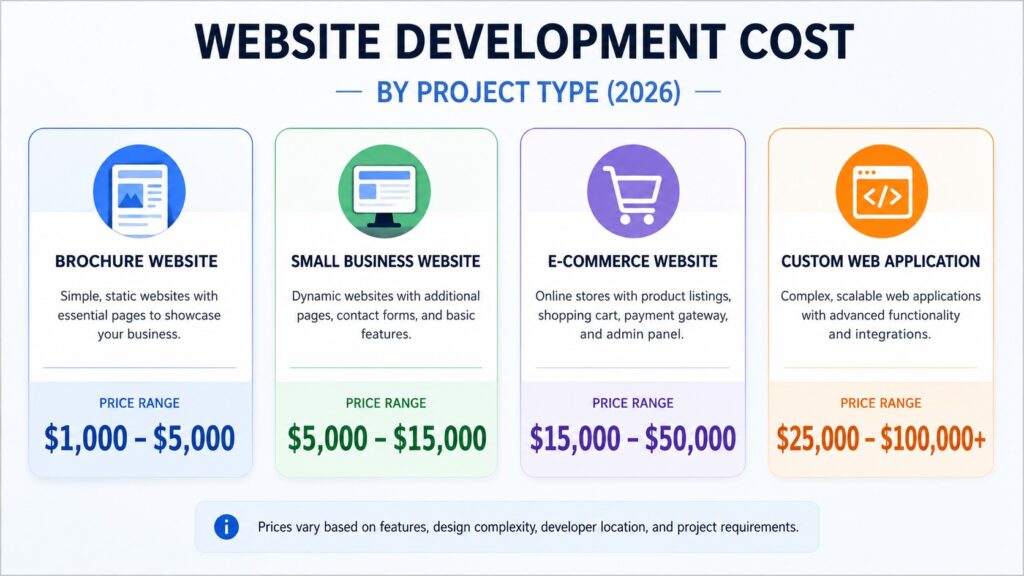
Here’s a more detailed breakdown. Treat these as realistic industry ranges, not fixed prices. Actual quotes will vary by developer, region, and project scope.
| Website Type | Typical Cost Range | What Drives the Price |
|---|---|---|
| Basic brochure/business site (3-7 pages) | $1,500 – $6,000 | Template-based design, standard pages (home, about, services, contact), minimal custom features |
| Small business site with custom features | $6,000 – $15,000 | Custom design elements, blog setup, lead forms, basic SEO structure, a few unique page layouts |
| E-commerce store | $8,000 – $30,000+ | Product catalog size, payment gateway integration, inventory management, custom checkout flow |
| Custom web application | $15,000 – $100,000+ | User accounts, custom dashboards, database-driven features, third-party API integrations, ongoing development complexity |
If you’re specifically looking at a custom-built application rather than a standard website, our guide on custom web application development costs goes deeper into how pricing scales with features and complexity.
If you’re on the smaller end of that table and just need a solid, professional site without a lot of custom development, our guide to small business web design is a good place to figure out what you actually need versus what you don’t.
For anyone specifically looking at an online store, e-commerce web design best practices covers the features that tend to push that price range up (and which ones are worth paying for).
And if you already have a website and you’re weighing a rebuild against a refresh, that’s a genuinely different cost question. We cover it in how much a website redesign costs in 2026.
DIY Builder vs. Freelancer vs. Agency: What Actually Changes
The price tag isn’t the only thing that changes depending on who builds your site. Speed, quality control, and what happens after launch all shift too.
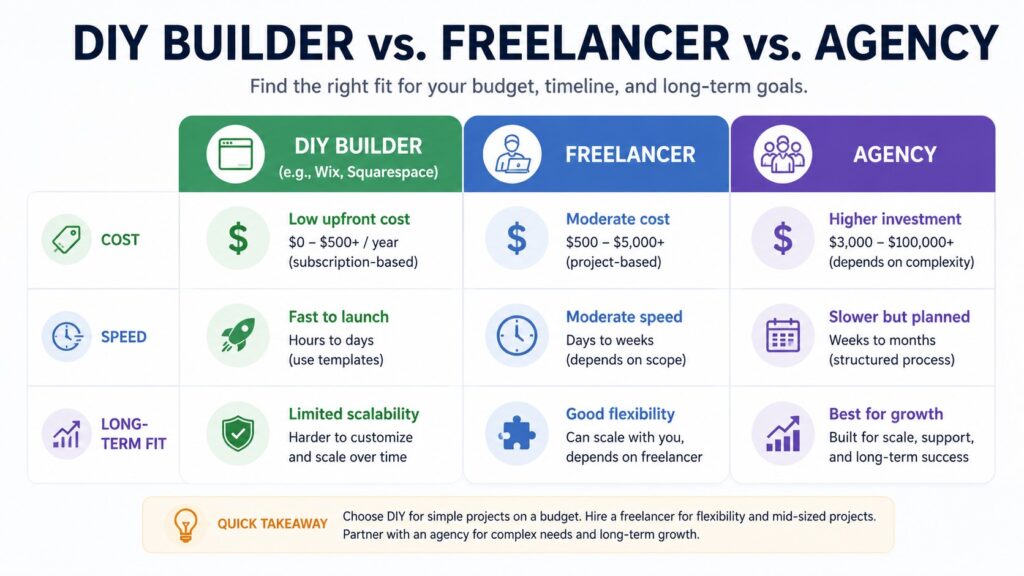
| Approach | Typical Cost | Speed | Customization | Long-Term Fit |
|---|---|---|---|---|
| DIY builder (Wix, Squarespace, etc.) | $0 – $500/year in subscription fees, plus your own time | Fast to launch, slow if you’re learning as you go | Limited to what the builder’s templates allow | Fine for very simple needs, harder to scale later |
| Freelancer | $500 – $10,000+ depending on scope | Varies widely by individual availability | High, but depends entirely on that one person’s skill set | Can be a risk if they become unavailable or move on |
| Agency | $2,000 – $100,000+ depending on scope | Generally more predictable, since a team is involved | High, with more consistent process and accountability | Usually more stable for ongoing support and updates |
A DIY builder makes sense if your needs are genuinely simple and you have time to learn the platform. You’ll save money upfront but you’re also doing the labor yourself, and you’re boxed into whatever that builder’s templates and plugins allow.
A freelancer can be a good middle ground, often more affordable than an agency with the flexibility of working directly with one person. The trade-off is that your project depends entirely on that one person’s availability, skill, and bandwidth. If they get busy with another client or move on to something else, you’re left without support.
An agency typically costs more, but you’re paying for a team, a process, and continuity. If something breaks after launch or you need changes down the road, there’s an established point of contact instead of hoping one freelancer picks up the phone. This is also where fixed-price, fixed-timeline models have become more common. Omayik Digital, for example, builds sites on a fixed 7-day delivery timeline with no hidden fees, which removes a lot of the guesswork that makes people nervous about agency pricing in the first place.
If you’re trying to figure out how to evaluate developers before committing, how to hire a web developer breaks down the freelancer versus in-house versus agency decision in more detail, and our guide on hiring dedicated web developers in the USA covers what to look for once you’ve decided.
If you’ve already decided an agency is the right call, what to look for in a web design agency is worth reading before you start reaching out to anyone.
The True Cost of Owning a Website (Not Just Building One)
This is the part most cost guides skip entirely, and it’s the part that catches people off guard six months after launch. Building the site is a one-time cost. Running it isn’t.
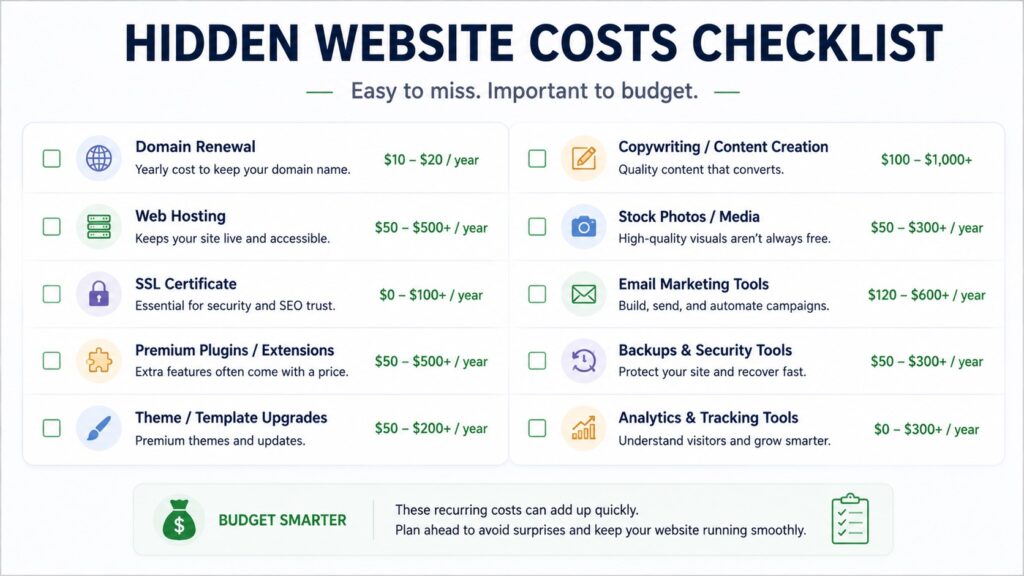
Here’s what typically continues after launch:
Domain renewal. Usually $10 to $20 per year, small but easy to forget until it lapses.
Web hosting. Ranges from $5 to $50 a month for standard shared or managed hosting, more if your site has heavy traffic or complex functionality.
SSL certificate. Often included free with hosting now, but worth confirming, since it’s required for basic security and search rankings.
Plugin and theme licenses. If your site runs on WordPress with premium plugins or themes, expect $50 to $300 a year in renewal fees, depending on how many you use.
Security monitoring and backups. Somewhere between $10 and $100 a month, depending on the level of protection and whether it’s managed for you or self-serve.
Content updates. If you’re not updating the site yourself, budget for either an hourly rate or a maintenance retainer with your developer or agency.
Ongoing SEO. Building the site doesn’t finish the SEO work. Ranking and staying visible in search takes ongoing effort, whether that’s content, technical maintenance, or both.
None of this makes building a website a bad investment. It just means the sticker price of the build isn’t the full financial picture. Budget for maintenance the same way you’d budget for any other piece of business infrastructure.
Hidden Costs People Forget to Budget For
Beyond the recurring costs above, a few one-time expenses tend to sneak up on people mid-project:
- Stock photography or licensing fees, if you don’t have your own product or brand photos
- Professional copywriting, if you’re not writing the site content yourself
- Payment processing fees for e-commerce (these are ongoing, usually a percentage per transaction, not a flat cost)
- Third-party integrations that weren’t scoped in the original quote (a booking calendar, a live chat widget, a CRM connection)
- Extra revision rounds beyond what was included in the original agreement
- Content migration, if you’re moving from an old site and need existing pages, blog posts, or product listings transferred over
None of these are dealbreakers. They’re just easy to miss if you don’t ask about them before the project starts.
How to Tell If a Web Development Quote Is Fair
Once you start collecting quotes, the range can feel enormous, sometimes by a factor of ten for what looks like the same project on paper. A few questions cut through that quickly:
What exactly is included? Ask for a written breakdown of pages, features, and revisions. A vague quote is harder to hold anyone accountable to.
What’s billed separately? Hosting, copywriting, stock photos, and ongoing maintenance are sometimes included and sometimes not. Get this in writing before you sign anything.
What’s the timeline, and is it fixed? Open-ended timelines tend to slip. A fixed delivery window, like a 7-day build model, gives you something concrete to plan around.
How many revision rounds are included? Unlimited revisions sound generous but can also mean a project that never actually finishes. Clear, bounded revision rounds usually lead to a better outcome for both sides.
Who owns the final files? Confirm you own the code, design files, and content once the project is paid for and completed. This matters if you ever want to switch developers later.
What happens after launch? Ask specifically what support is included once the site goes live, and for how long. A 30-day post-launch support window, for example, gives you a real safety net for the inevitable small tweaks that come up once the site is actually being used.
If a developer or agency can answer all of this clearly and it lines up with what you’re being asked to pay, that’s usually a good sign you’re looking at a fair, transparent quote rather than a lowball that gets padded with add-ons later.
How AI Is Changing Web Development Costs in 2026
One real shift worth mentioning: AI-assisted development tools have sped up a lot of the repetitive work involved in building websites, from initial layout generation to code scaffolding. That’s making some projects faster to deliver than they would have been a few years ago, which in turn is putting pressure on the “it takes 6-8 weeks minimum” assumption that used to be standard in this industry.
At the same time, AI is also becoming part of what gets built, not just how it gets built. AI chatbots and AI voice agents are increasingly bundled into small business websites as an added layer of customer interaction, handling things like answering common questions or booking appointments outside business hours. This is worth asking about specifically if you’re comparing quotes, since a website plus a working AI chatbot is a different scope than a website alone.
None of this means development is now free or instant. It means the timeline and cost expectations that used to be standard are shifting, and it’s worth asking any developer or agency you’re considering how they’re using these tools in their process.
Getting a Realistic Number for Your Project
If you’ve made it this far, you probably have a rough sense of where your project lands. A simple brochure site for a local business is a very different budget conversation than a custom booking platform or an online store with hundreds of products.
The most reliable way to get an accurate number is still to describe your actual project, pages, features, integrations, and timeline, to a developer directly and ask for a specific quote rather than relying on averages. Omayik Digital offers a free discovery call and builds on fixed pricing with no hidden fees, so you know the full cost before any work starts, on a 7-day delivery timeline. You can see examples of past work in the portfolio or get in touch to talk through what your specific project would actually cost.
Looking for more detail on a specific type of project? Check out our guides on web design packages and pricing or hiring a professional web designer for more ways to narrow down your options.

Leave a Reply