

Hire Dedicated Web Developers in the USA: How to Find the Right Fit Without the Guesswork
Most businesses don’t have a developer shortage. They have a hiring strategy problem.
You’ve probably been there. You post a job, get flooded with applications, spend three weeks interviewing, hire someone who looked great on paper, and two months in you’re back to square one. Or you go the agency route, pay a premium, and get handed off to a junior developer you’ve never met.
There’s a better model. And more product teams are figuring that out.
Hiring a dedicated web developer isn’t about finding the cheapest resource or the biggest agency. It’s about finding someone who operates like a core part of your team without the overhead of a full-time hire. Done right, it’s one of the most efficient ways to build and scale a digital product.
This article walks you through how to do it properly, using a framework developed by the team at Omayik Digital based on what actually works for long-term engagements.
Why More Businesses Are Moving to the Dedicated Developer Model in 2026
The project-based agency model made sense when websites were brochures. You scoped the project, signed a contract, launched, and moved on.
That’s not how digital products work anymore.
Products evolve. Features get added. Systems break. Markets shift. A team that hands you a finished product and disappears is not built for that reality.
The Shift from Project-Based Agencies to Embedded Developers
What’s changed isn’t just technology. It’s how businesses think about technical capacity.
More companies are treating development less like a project and more like a function. That means they need developers who understand the codebase, know the business logic, and can make decisions without being re-briefed every two weeks.
Embedded, dedicated developers fill that gap. They work inside your workflow, use your tools, attend your standups, and build context over time. That context has real value. A developer who has worked on your product for six months moves three times faster than a new contractor who needs to get up to speed.
What “Dedicated” Actually Means (and What It Does Not)
A dedicated developer is not a freelancer you message on Slack when something breaks.
The dedicated model means one developer (or a small, consistent team) is allocated specifically to your project for an agreed period. Their hours are yours. Their attention is not divided across five other clients.
This is different from a managed service or a project retainer. You are not buying deliverables. You are buying capacity, consistency, and commitment.
The Hidden Cost of Context-Switching That Most Businesses Overlook
Every time you bring in a new developer, you pay an invisible tax.
There’s the time they spend reading your documentation (if it exists), understanding your architecture, learning how you communicate, and figuring out what “done” means to your team. Research from the University of California Irvine suggests it takes an average of 23 minutes to fully regain focus after a context switch. Now multiply that across a developer re-onboarding to a new codebase.
Dedicated developers eliminate that tax. The longer they work with you, the more efficient the engagement gets.
Is This the Right Model for You? Introducing the PACE Framework
Before you start writing job posts or reaching out to agencies, answer this question honestly: do you actually need a dedicated developer, or do you need a project completed?
Those are different problems with different solutions.
The PACE Framework helps you figure out which one you’re dealing with.
P: Project Complexity. Is Your Build Ongoing or One-Time?
If you need a marketing website built and launched by Q3, hire an agency or a project-based contractor.
If you’re building a SaaS product, an e-commerce platform, or any system that will need continuous development after launch, you need someone who stays. A dedicated developer’s value compounds over time. A contractor’s value ends when the project does.
A: Accountability. Do You Need Someone Operationally Tied to Your Outcomes?
Freelancers are accountable to their invoice. Dedicated developers, when structured properly, are accountable to your roadmap.
That means they’re in your sprint reviews. They flag problems early. They have a stake in the outcome because their continued engagement depends on it. When something breaks at 9pm, they’re not ignoring your message because they’re mid-project for another client.
C: Communication. How Much Real-Time Collaboration Does Your Workflow Require?
Time zone compatibility is a real constraint, not a minor inconvenience.
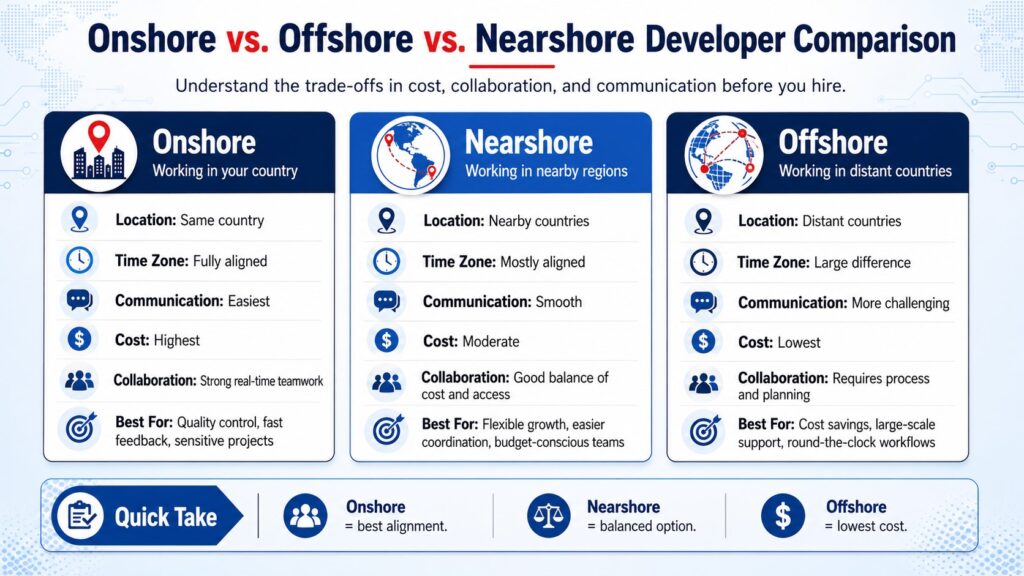
If your team does daily standups, requires same-day feedback loops, or works in a fast-moving Agile environment, you need a developer who overlaps with your working hours. A US-based dedicated developer gives you full overlap. Nearshore developers (Latin America) give you 4-6 hours. Offshore (South/Southeast Asia) may give you little to none.
Be honest about how your team actually works before making this decision.
E: Engagement Length. Are You Building a Product or Completing a Task?
Short answer: if the work ends in 90 days, use a contractor. If it goes beyond that, the dedicated model starts paying for itself.
The onboarding investment required for any developer starts making financial sense around the 3-month mark. Beyond that, you’re getting a team member who knows your system and can move without hand-holding.
What It Actually Costs to Hire a Dedicated Web Developer in the USA
Let’s talk numbers without the vague ranges most articles hide behind.
Hourly Rate Ranges by Developer Type and Seniority (2026 Data)
Here’s what the market actually looks like for US-based dedicated web developers in 2025:
| Developer Type | Junior (0-2 yrs) | Mid-Level (3-5 yrs) | Senior (6+ yrs) |
|---|---|---|---|
| Front-End Developer | $55-$75/hr | $80-$110/hr | $120-$150/hr |
| Back-End Developer | $60-$80/hr | $90-$120/hr | $130-$160/hr |
| Full-Stack Developer | $65-$85/hr | $95-$130/hr | $140-$175/hr |
| DevOps / Cloud Engineer | $70-$90/hr | $100-$135/hr | $145-$185/hr |
For full-time dedicated engagements (160 hours/month), that translates to monthly retainers ranging from roughly $9,000 to $28,000 depending on seniority and specialization.
Onshore, Nearshore, and Offshore: A Straight Comparison
| Factor | USA (Onshore) | Latin America (Nearshore) | South/SE Asia (Offshore) |
|---|---|---|---|
| Avg. Hourly Rate | $75-$175 | $35-$75 | $20-$50 |
| Time Zone Overlap | Full | Partial (4-6 hrs) | Minimal |
| Communication Ease | High | High | Variable |
| IP & Legal Protection | Strong | Moderate | Varies by country |
| English Proficiency | Native | Generally strong | Variable |
Neither option is universally better. The right choice depends on your PACE score.
What the Rate Does Not Cover
The hourly rate is not your total cost. Budget separately for:
- Project management overhead: 5-10% of total development time if you’re coordinating yourself
- Tools and licenses: IDEs, project management platforms, design handoff tools
- Code review or QA: If your dedicated developer isn’t senior, factor in review time from someone who is
- Onboarding time: The first 2-4 weeks are slower. That’s normal. Build it into your budget.
When Paying More Upfront Saves Money Long-Term
A senior full-stack developer at $140/hr who needs zero hand-holding and writes clean, documented code will cost you less over 12 months than a junior at $65/hr who requires constant supervision and produces technical debt you’ll pay someone else to fix later.
That’s not an opinion. It’s arithmetic.
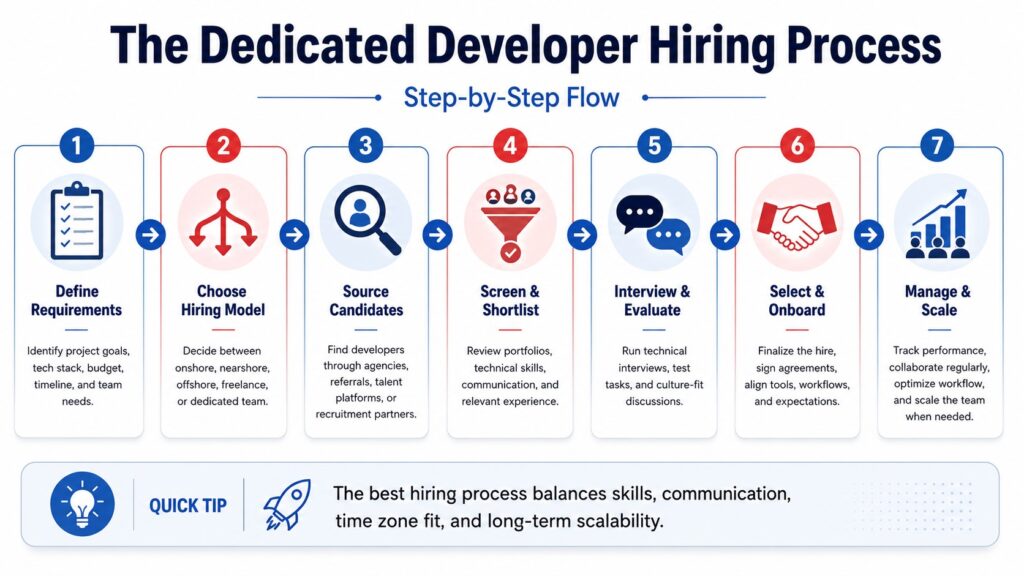
How to Find and Vet Dedicated Web Developers Without Wasting Weeks
The hiring process for a dedicated developer is not the same as posting a job on LinkedIn and waiting.
Where to Actually Look
The obvious platforms (Upwork, Toptal, LinkedIn) are not wrong. But they’re the beginning, not the strategy.
Here’s a more targeted approach:
- GitHub: Search for active contributors to open-source projects using your tech stack. Someone with 300+ commits, clean pull request history, and public repositories tells you more than any resume.
- Specialist agencies: Firms like Omayik Digital pre-vet developers and match them to specific engagement types. You skip the sorting problem.
- Developer communities: Slack communities, Discord servers, and Stack Overflow job boards surface developers who are actively building, not just job hunting.
How to Read a Developer Portfolio If You Are Not Technical
You don’t need to understand the code. You need to understand the decisions.
Ask these questions about any portfolio piece: What problem did this solve? What did they build specifically (not the team, them)? What would they do differently now? Weak portfolios describe outcomes. Strong portfolios explain reasoning.
Also look for documentation. A developer who writes clear READMEs and comments their code is a developer who communicates. That matters more than most non-technical hiring managers realize.
The Trial Sprint Method
Skip the whiteboard interview. Run a paid trial sprint instead.
Give candidates a small, real task from your actual project. Pay them their stated rate for 8-16 hours of work. Evaluate not just the output but how they communicate during the process. Do they ask good questions? Do they flag blockers early? Do they deliver what they said they would?
This tells you more in two days than five rounds of interviews.
Red Flags That Most Non-Technical Hiring Managers Miss
- They can’t explain their past work without using jargon as a shield
- Their portfolio is all design screenshots with no backend or logic examples
- They’ve never worked in an Agile environment and aren’t sure what a sprint is
- They’re vague about their role in past team projects
- They push back on a trial sprint (a confident developer welcomes the chance to show their work)
Setting Up the Engagement for LongTerm Success
Finding the right developer is half the job. Structuring the engagement properly is the other half.
Contracts, Hours, and Setting Clear Expectations from Day One
Get three things in writing before anyone writes a line of code:
Scope of work: What are they responsible for? What is explicitly out of scope?
IP ownership: Every piece of code, design, or documentation created during the engagement belongs to you. This should be unambiguous in the contract.
Communication norms: How often do you sync? What’s the response time expectation for urgent issues? Which tools are you using?
These conversations feel administrative. They prevent 80% of engagement breakdowns.
Tools That Keep Remote Developer Relationships on Track
You don’t need a complex stack. You need a consistent one.
- Linear or Jira for sprint and task management
- GitHub or GitLab for version control and code review
- Loom for async video updates when a live call isn’t necessary
- Slack for daily communication with clear channel structure
The tool matters less than the discipline around using it consistently.
How to Set KPIs That Actually Reflect Progress
Avoid vanity metrics like “lines of code written” or “tickets closed.”
Better KPIs for a dedicated developer engagement:
- Sprint velocity (are they completing what they commit to?)
- Bug introduction rate (are they creating problems while solving others?)
- Code review feedback frequency (are review comments decreasing over time, indicating learning?)
- Feature delivery against roadmap (are milestones being hit?)
Review these monthly. Have a direct conversation when something’s off. Good developers want that feedback.
How Omayik Digital Structures Dedicated Developer Engagements
Omayik Digital uses a 3-phase onboarding model for every new engagement: a discovery week to align on architecture and workflow, a two-week calibration sprint to establish pace and communication rhythm, and then a rolling 4-week sprint cycle with bi-weekly reviews.
This structure exists because the first 30 days of a dedicated engagement determine whether it succeeds or fails. Getting it right early means clients rarely need to restart.
Common Mistakes Businesses Make When Hiring Dedicated Developers
These aren’t rare edge cases. They happen regularly, across industries and company sizes.
Hiring for the Wrong Skill Set Because the Brief Was Vague
“We need a web developer” is not a brief.
Do you need someone who specializes in React.js and modern front-end architecture? A Node.js back-end developer who can build and maintain APIs? A full-stack developer who can handle both but may go less deep on either?
Each is a different hire. Writing a vague job post attracts generalists and wastes everyone’s time. Know what you need before you start looking.
Skipping the Trial Period to Save Time
This is the most expensive shortcut in tech hiring.
A two-week trial sprint might cost you $1,500 to $3,000. Hiring the wrong developer for a six-month engagement costs you that, plus the time lost, plus the cost of finding and onboarding their replacement.
The trial is not optional. It’s insurance.
Confusing Availability With Dedication
A developer who is “available” is not the same as one who is dedicated to your project.
Some contractors take on three or four clients simultaneously and manage time across all of them. They’re technically available. But they’re not focused. Ask directly: how many active clients are you currently serving? What percentage of your working hours will be allocated to our project?
A legitimate dedicated engagement means you get a defined allocation, not whatever time is left over.
Ignoring Compliance, IP Ownership, and Contract Clarity
This is especially relevant when hiring across borders but applies domestically too.
W3C standards, WCAG accessibility compliance, and data handling regulations vary by industry and jurisdiction. Make sure your developer understands the compliance requirements of your product and that your contract explicitly assigns all IP to your company.
One overlooked clause can create a legal dispute that costs more than the entire engagement.
Why Omayik Digital Is a Trusted Partner for Businesses Hiring Dedicated Web Developers in the USA
Omayik Digital works with startups, scale-ups, and established businesses that need dedicated web development capacity without the complexity of building an internal team from scratch.
How Omayik Digital’s Vetting Process Works
Every developer in Omayik Digital’s network goes through a four-stage evaluation: a technical skills assessment specific to their stack, a real-world problem-solving exercise, a communication and collaboration review, and a reference check from prior engagement leads.
The result is a pool of developers who can actually do the work and communicate clearly about it. Both matter.
What a Typical Engagement Looks Like
A client comes to Omayik Digital with a product need. The team runs a scoping session to understand the technical requirements, team structure, and timeline. Within 5-7 business days, they match the client with a vetted developer or small team, facilitate a kickoff, and begin the calibration sprint.
After that, the client has a direct working relationship with their developer. Omayik Digital stays involved for oversight, performance reviews, and any escalations.
Who Omayik Digital Is the Right Fit For (and Who It Is Not)
Omayik Digital works best for businesses that:
- Need a developer for at least three months of ongoing work
- Have a defined product or platform, not just a vague concept
- Want a structured engagement with accountability built in
It’s not the right fit for one-off projects with a fixed end date or businesses that need a developer to start tomorrow without any onboarding process.
If that’s your situation, a project-based agency or a freelance marketplace will serve you better. Omayik Digital will tell you that directly rather than take on an engagement that won’t work.
FAQ
What does it mean to hire a dedicated web developer?
A dedicated web developer works exclusively on your project for an agreed period, fully integrated into your workflow, not split across multiple clients.
Unlike a freelancer juggling several projects at once, a dedicated developer brings their full attention to your product. Over time, they build context and move faster because they understand your system, your goals, and how your team works.
How much does it cost to hire a dedicated web developer in the USA?
US-based dedicated developers typically charge between $75 and $175 per hour, with full-time monthly retainers ranging from $9,000 to $28,000 depending on seniority and specialization.
The rate varies significantly based on the tech stack, experience level, and engagement structure. Senior full-stack developers command the highest rates but often deliver better long-term value than cheaper, less experienced alternatives.
Is it better to hire a dedicated developer or use a development agency?
It depends on whether you need ongoing product development or a one-time project delivered and closed.
Agencies are better suited to scoped, time-bound builds. A dedicated developer is the stronger choice when your product will need continued development, iteration, and technical decision-making beyond the initial launch.
How do I verify the skills of a web developer before hiring them?
Run a paid trial sprint using a real task from your project. Review their GitHub commit history, ask them to explain past work, and pay attention to how they communicate during the process.
The trial sprint tells you more than any interview. You’re not evaluating performance under exam conditions. You’re evaluating how they actually work.
Can I hire a dedicated web developer in the USA for a long-term project?
Yes, and for most ongoing digital products, it’s the smarter structural choice over repeatedly re-hiring contractors.
A long-term dedicated developer accumulates product knowledge that shortens feedback loops, reduces onboarding costs, and improves code consistency over time. The engagement pays for itself the longer it runs.
Leave a Reply