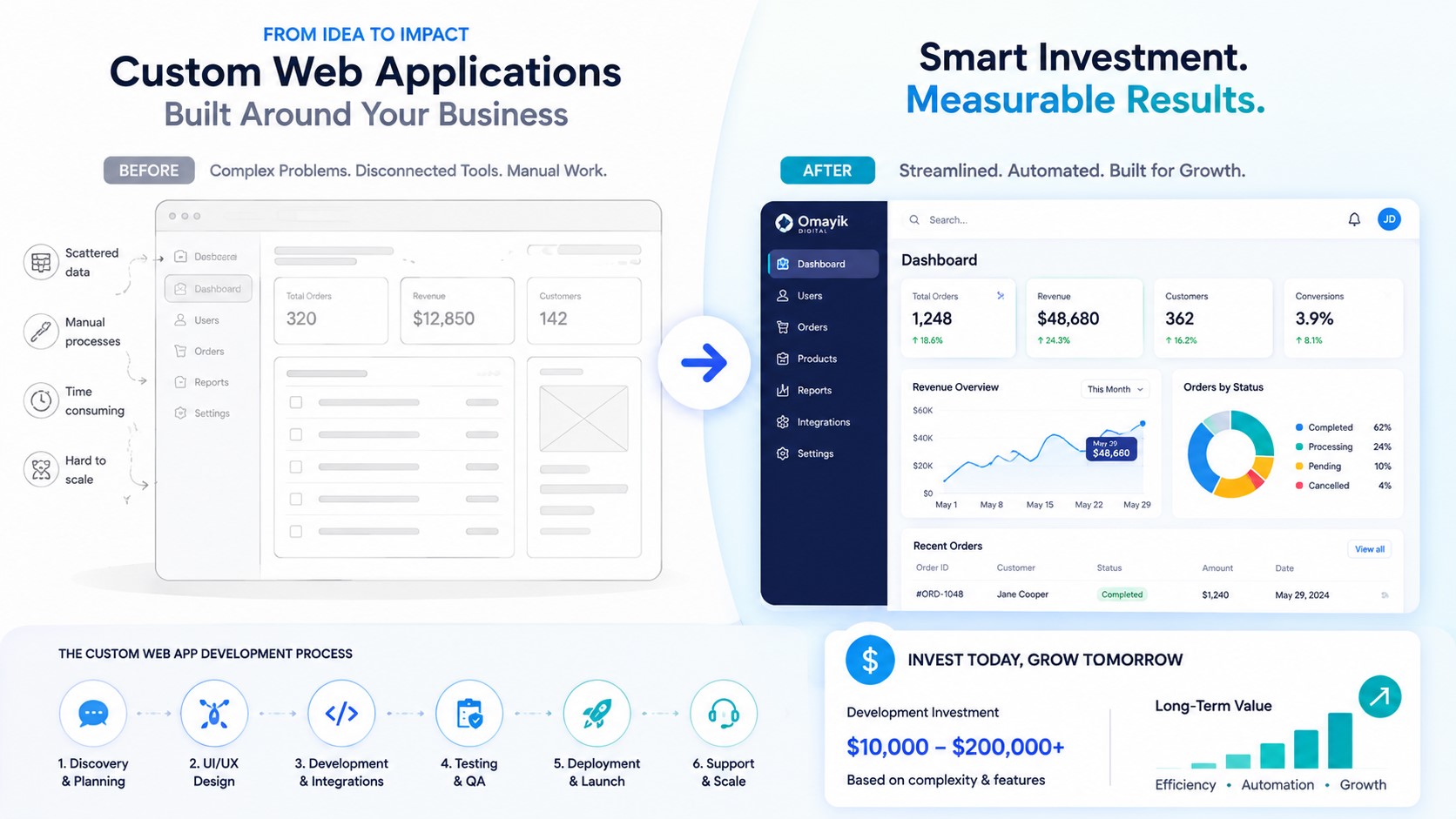
Custom Web Application Development Cost: A 2026 Pricing and Process Guide
If you’ve asked a few development companies for a quote on a custom web application, you’ve probably gotten three wildly different numbers back. One agency says $15,000. Another says $80,000. A freelancer on the other side of the world offers to do it for $6,000. None of them explain why.
That gap is confusing, and it makes budgeting feel like guesswork. Get it wrong and you either overpay for something simple, or you underbudget and run out of money halfway through development. This guide breaks down what actually drives the cost of custom web application development, what the process looks like from start to finish, and how to pick a provider who won’t waste your time or your money.
Contact Us: https://omayikdigital.com/contact-us/
Simple pricing: https://omayikdigital.com/pricing-plans/
What Is Custom Web Application Development?
Custom web application development means building software specifically for your business, rather than buying a pre-built tool and adjusting it to fit. Think of the difference between renting a furnished apartment and having a house built to your own floor plan. Off-the-shelf software (like a standard CRM or project management tool) works well when your needs match what most businesses need. A custom web app makes sense when your workflow, data, or customer experience doesn’t fit neatly into someone else’s template.
Examples include internal tools for managing inventory across multiple warehouses, customer-facing platforms with unique booking logic, or dashboards that pull data from several systems your business already uses.
How Much Does Custom Web Application Development Cost?
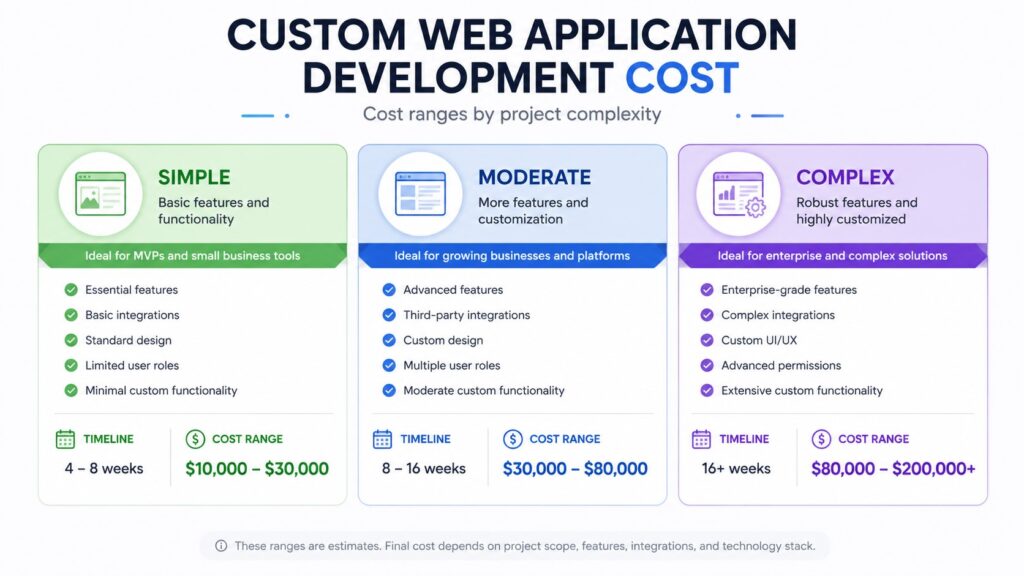
Most custom web applications cost somewhere between $15,000 and $250,000, depending on complexity. There’s no single “average price” because a simple internal tool and a multi-user platform with payment processing are entirely different projects with different risks and requirements.
Here’s a realistic breakdown by complexity tier:
| Complexity Tier | Typical Cost Range | Example |
|---|---|---|
| Simple / MVP | $15,000 – $40,000 | Basic internal tool, single-user dashboard, simple booking form |
| Mid-complexity | $40,000 – $100,000 | Customer-facing app with user accounts, payments, or third-party integrations |
| High complexity | $100,000 – $250,000+ | Multi-role platform, complex workflows, compliance requirements, multiple integrations |
These ranges assume a professional agency or experienced team. Freelancers can come in lower, and large enterprise firms can run higher. Treat these numbers as a starting point for budgeting conversations, not a fixed quote. The only way to get an accurate number is to walk through your specific requirements with a development team.
Contact Us: https://omayikdigital.com/contact-us/
Simple pricing: https://omayikdigital.com/pricing-plans/
What Drives the Price Up or Down
A handful of factors explain most of the price difference between projects:
- Number of features and user roles. An app with one type of user (say, just customers) is simpler than one with customers, admins, and internal staff who each see different things.
- Third-party integrations. Connecting to payment processors, CRMs, shipping APIs, or existing internal systems adds development and testing time.
- Custom design vs. templated UI. A fully custom interface takes longer to design and build than one based on existing component libraries.
- Data security and compliance needs. Handling payment data, health information, or personal data under regulations like GDPR adds architecture and testing overhead.
- Team location and structure. Onshore agencies typically charge more per hour than offshore teams, though hourly rate alone doesn’t tell you the full cost story (more on that below).
- Ongoing maintenance. Development cost is only part of the picture. Hosting, bug fixes, and updates after launch are recurring costs you need to plan for separately.
What Factors Affect Web App Development Pricing
Beyond the broad drivers above, a few specific details tend to catch people off guard when they’re budgeting for the first time.
Scope clarity matters more than most people expect. A vague brief like “build us a customer portal” leaves too much open to interpretation, and every unanswered question either gets guessed at (badly) or turns into a change request later, which costs more than if it had been scoped upfront.
The number of platforms you need also matters. A web app that only needs to work on desktop browsers is cheaper than one that needs to be fully responsive across phones, tablets, and desktops, and cheaper still than one that also needs a companion mobile app.
Finally, don’t overlook QA and testing time. Thorough testing, especially for anything involving payments, user data, or multiple integrations, can account for a meaningful chunk of total project hours. Providers who quote unusually low often cut here first.
The Custom Web Application Development Process
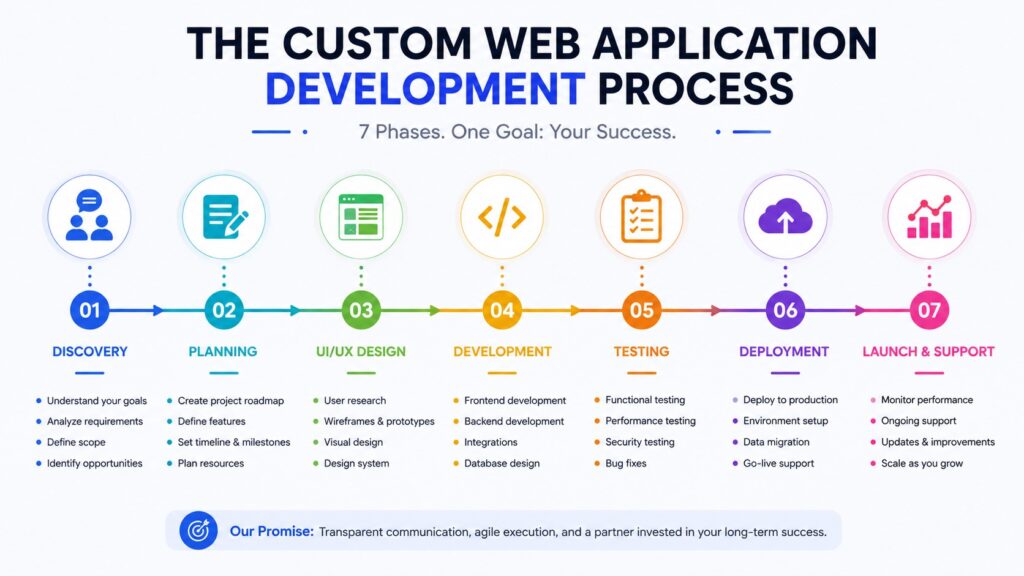
A well-run custom development project moves through roughly seven phases. Knowing what happens at each stage helps you understand where your money goes and what’s expected from you as the client.
1. Discovery and Requirements Gathering
This is where the development team learns your business, your users, and what problem the app needs to solve. Expect meetings or workshops where you’ll be asked detailed questions about workflows, user types, and existing systems. Skipping or rushing this phase is one of the most common reasons projects go over budget later.
2. Planning, Architecture, and Tech Stack Selection
The team decides how the app will be built technically: which programming languages, frameworks, and databases make sense, and how the system will be structured to handle your expected users and data. This phase also usually produces a project timeline and a more precise cost estimate than what you got in the initial sales conversation.
3. UI/UX Design
Designers create wireframes and visual mockups showing how the app will look and function before any code is written. You’ll typically review and approve designs at this stage, which is much cheaper to revise than waiting until after development.
4. Development (Sprints or MVP Build)
Developers build the application, usually in short cycles called sprints, each producing a working piece of functionality. Many teams start with a minimum viable product (MVP), a stripped-down version with core features only, so you can test the concept before investing in every feature.
5. Testing and QA
The app gets tested for bugs, security issues, and performance problems across different devices and browsers. This includes both automated testing and manual checks by real people trying to break things the way real users eventually will.
6. Launch and Deployment
The application goes live on your servers or cloud hosting. This step includes final checks, setting up monitoring, and making sure everything works in the live environment the same way it did in testing.
7. Post-Launch Support and Maintenance
Software needs upkeep. Bugs surface once real users start interacting with the app, security patches need applying, and you’ll likely want new features over time. Budget for this as an ongoing cost, not a one-time expense.
Contact Us: https://omayikdigital.com/contact-us/
Simple pricing: https://omayikdigital.com/pricing-plans/
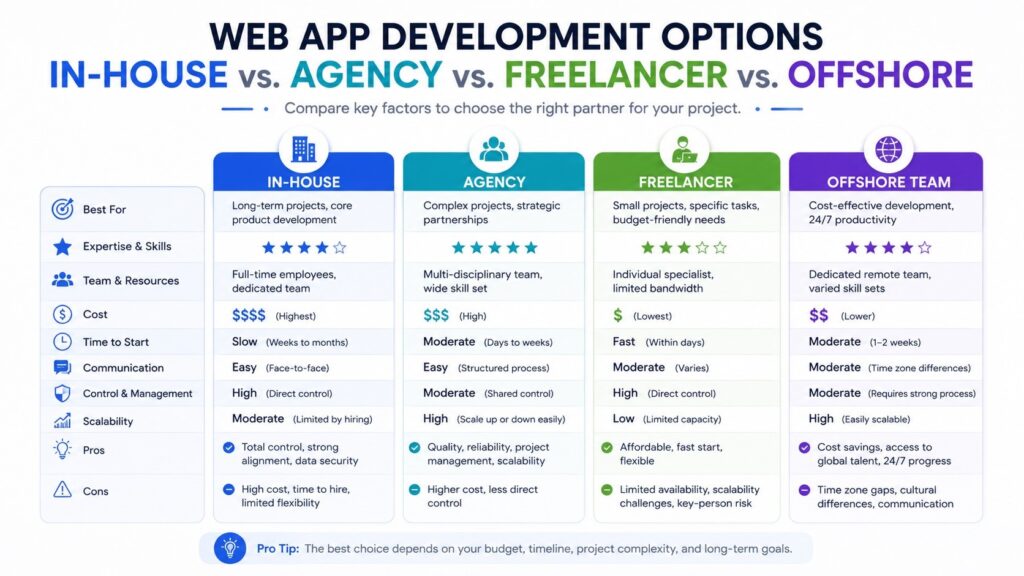
In-House vs. Agency vs. Freelancer vs. Offshore Team
Who builds your app matters as much as how it’s built. Each option comes with different tradeoffs.
| Option | Cost | Control | Speed | Risk |
|---|---|---|---|---|
| In-house team | Highest (salaries, benefits, tools) | Highest | Slower to start, faster once staffed | Low, but expensive to scale down |
| Agency | Mid to high | Moderate | Fast to start, structured process | Low, established processes |
| Freelancer | Lowest | High day-to-day, low oversight | Varies widely | Higher (single point of failure) |
| Offshore team | Low to mid | Moderate | Fast, but timezone dependent | Moderate (communication, quality variance) |
In-house teams make sense if you need ongoing development for years and can justify the overhead of salaries and management. Agencies work well for defined projects where you want a proven process and a team that’s worked together before. Freelancers can be a good fit for small, well-defined tasks, but a single freelancer disappearing mid-project is a real risk on anything complex. Offshore teams can lower cost significantly, but communication gaps and quality control need more active management on your end.
Contact Us: https://omayikdigital.com/contact-us/
Simple pricing: https://omayikdigital.com/pricing-plans/
How to Choose the Right Web App Development Provider
There’s no single “best” provider for every project. The right choice depends on your budget, timeline, and how much oversight you want to provide. That said, a few things separate reliable providers from risky ones.
Questions to Ask Before Hiring a Development Team
- Can you show examples of similar projects you’ve built before?
- What does your discovery and planning process actually involve?
- How do you handle scope changes once development starts?
- What happens after launch? Is maintenance included or separate?
- Who owns the code and intellectual property once the project is done?
Red Flags to Watch For
- A quote given before any real discovery conversation happens
- No clear process or timeline, just “we’ll figure it out as we go”
- Reluctance to put deliverables and payment terms in writing
- Prices dramatically lower than every other quote you’ve received
- No mention of testing, QA, or post-launch support
What a Reliable Provider Should Offer
A trustworthy development partner walks you through a clear process, gives you a realistic (not just optimistic) timeline, and is upfront about pricing before asking for a commitment. They should be able to show you custom web application development services they’ve actually delivered, not just describe capabilities in the abstract. Omayik Digital LLC follows this kind of structured approach, starting with discovery and scoping before any development work begins, so clients know what they’re paying for and why. If you want to see the kind of work this looks like in practice, you can explore our recent web development projects.
Common Mistakes to Avoid When Budgeting for a Custom Web App
- Underestimating maintenance costs. Development is a one-time expense, but hosting, updates, and bug fixes are ongoing. Budget for both.
- Skipping the discovery phase to save time. This almost always costs more later in the form of rework and scope changes.
- Choosing the lowest bid without asking why it’s low. Cheaper quotes often mean less testing, less experienced developers, or vague scope that leads to change orders.
- Ignoring scalability. Building only for today’s user count can mean an expensive rebuild later if your business grows faster than expected.
- Leaving scope undefined. A vague project brief leads to misaligned expectations and disputes over what was actually promised.
Practical Tips for Keeping Your Project on Budget
- Start with an MVP. Build the core functionality first, launch it, and add features based on real user feedback rather than guesses.
- Choose fixed-scope pricing for well-defined projects. Time-and-materials pricing works better for projects where requirements are likely to evolve.
- Review progress at set milestones. Regular check-ins catch misalignment early, before it turns into expensive rework.
- Get scope changes in writing. Verbal agreements about “just adding one more feature” are how budgets quietly balloon.
- Ask for a maintenance estimate upfront. Knowing your post-launch costs before you start avoids budget surprises later.
Key Takeaways
- Custom web app costs typically range from $15,000 for simple tools to $250,000+ for complex, multi-role platforms.
- Cost is driven by features, integrations, design complexity, compliance needs, and team location.
- The development process runs through discovery, planning, design, development, testing, launch, and ongoing maintenance.
- In-house, agency, freelance, and offshore options each carry different cost, control, and risk tradeoffs.
- The lowest quote isn’t always the cheapest option once you factor in rework, delays, and missed requirements.
Frequently Asked Questions
How much does it cost to build a custom web application? Most custom web apps cost between $15,000 and $250,000, depending on complexity. A simple internal tool sits at the lower end, while a platform with multiple user roles, payment processing, and third-party integrations sits at the higher end. The only way to get an accurate figure for your project is a scoping conversation with a development team.
How long does custom web app development take? Simple applications can take 2 to 4 months from discovery to launch. Mid-complexity projects typically take 4 to 8 months, and highly complex platforms can take a year or more. Timeline depends heavily on how clearly the scope is defined before development starts.
Is it cheaper to hire a freelancer or an agency for a web app? Freelancers usually cost less upfront, but they carry more risk on complex projects since you’re relying on one person’s availability and skill set. Agencies cost more but offer a full team, established processes, and more accountability if something goes wrong mid-project.
What ongoing costs should I budget for after launch? Plan for hosting or cloud infrastructure costs, security updates, bug fixes, and periodic feature updates. Many providers offer maintenance packages, which typically run a percentage of the original development cost per year. Ask about this before signing a contract, not after launch.
Do I need a custom web app, or would an off-the-shelf tool work? If your workflow, branding, or data needs fit within what an existing tool offers, an off-the-shelf solution is usually faster and cheaper. Custom development makes sense when your requirements are specific enough that you’d be working around a tool’s limitations rather than with them.
Ready to Scope Your Project?
Custom web application development is an investment, and the cost varies a lot depending on what you’re building and how it’s built. The businesses that stay on budget are usually the ones that invest time in discovery upfront and choose a provider who’s transparent about process and pricing from the first conversation.
If you’re ready to get a realistic quote for your project, get a project quote from Omayik Digital LLC and start with a proper scoping conversation instead of a guess.
Contact Us: https://omayikdigital.com/contact-us/
Simple pricing: https://omayikdigital.com/pricing-plans/
Leave a Reply