

Small Business Web Design: Affordable Solutions That Actually Convert
You built a website. You’re getting some traffic. But the phone isn’t ringing, the contact form sits empty, and your competitor — with a site that looks worse than yours — keeps landing clients.
Sound familiar?
Here’s the uncomfortable truth: most small business websites are built to exist, not to convert. They check the box without doing the job. And when you’re running a business on a tight budget, a website that doesn’t pull its weight isn’t just useless — it’s expensive.
The good news? You don’t need a $5k budget or a fancy agency to get a website that actually works. You need the right approach.
Simple pricing. No surprises: https://omayikdigital.com/pricing-plans/
Why Most Small Business Websites Fail to Convert
Built to Look Good, Not to Sell
A beautiful website with no clear direction is like a gorgeous storefront with no sign, no door, and no staff. Visitors show up, look around, and leave.
Most budget web designs focus on aesthetics. They pick a nice theme, add a logo, write “Welcome to our website” on the homepage, and call it done. But visitors don’t care about looks as much as they care about clarity.
- Can I find what I need in 5 seconds?
- Do I trust this business?
- What do I do next?
If your website doesn’t answer those three questions immediately, people leave.
Common Design Mistakes That Cost You Customers
- No clear call to action (CTA) on the homepage
- Slow loading speed (a 1-second delay can reduce conversions by 7%)
- Not mobile-optimised — over 60% of web traffic comes from phones
- No trust signals: testimonials, reviews, certifications, or portfolio
- Cluttered layouts that confuse visitors instead of guiding them
What Makes a Small Business Website “Convert”?
A converting website is one that turns visitors into leads, calls, bookings, or sales — consistently.
The Key Elements Every High-Converting Website Needs
- A clear headline that tells visitors exactly what you do and who you serve
- One primary CTA above the fold (e.g., “Get a Free Quote” or “Book a Call”)
- Social proof — at least 3–5 real testimonials or a portfolio
- Fast load time — under 3 seconds, tested on mobile
- Simple navigation — visitors should never wonder where to click next
- Contact options — phone number, WhatsApp link, or contact form visible on every page
Mobile-First Design Is Non-Negotiable
If your website looks great on desktop but breaks on a phone, you’re turning away the majority of your visitors. Google also ranks mobile-friendly sites higher in search results. Any web design solution you consider must be tested and optimised for mobile first.
Speed, Trust, and Clarity: The Conversion Triangle
Think of website conversion as a triangle with three points: speed, trust, and clarity.
- Speed — If it loads slowly, people leave before they see anything
- Trust — If it looks untrustworthy, people won’t take action
- Clarity — If it’s confusing, people won’t know what to do
Fix all three, and your conversion rate improves dramatically — regardless of your budget.
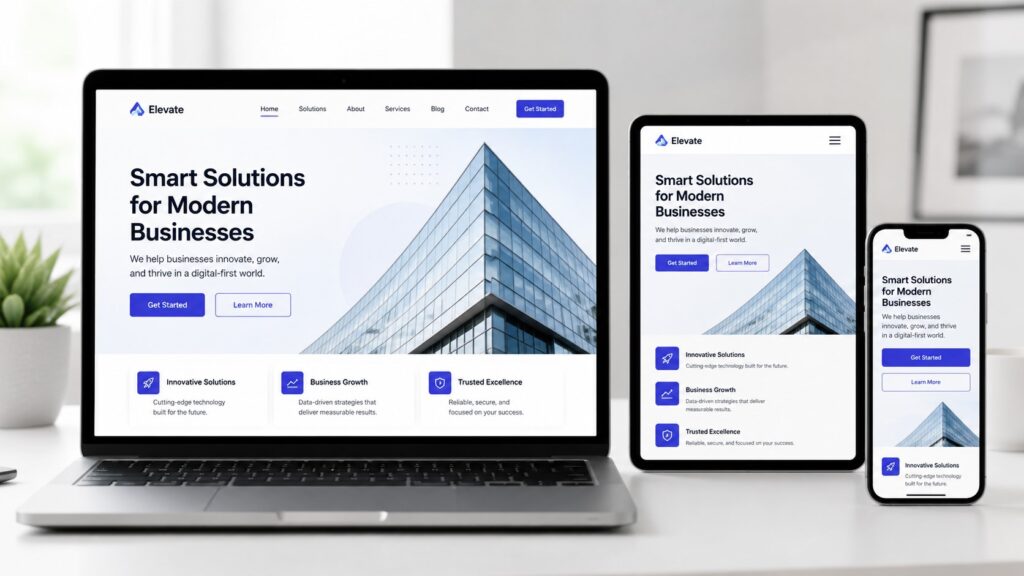
How Much Does Small Business Web Design Actually Cost?
Web design pricing varies wildly, and understanding what you’re paying for helps you avoid being overcharged or underprepared.
DIY Website Builders: Pros, Cons, and Real Costs
Platforms like Wix, Squarespace, or WordPress.com let you build your own site without coding.
Typical cost: $15–$40/month (plus domain)
Pros:
- Low upfront cost
- Easy to update yourself
- Good templates available
Cons:
- Time-consuming if you’re not design-savvy
- Limited customisation
- Often look generic
- SEO capabilities are basic
Best for: Solopreneurs or very early-stage businesses testing the waters.
Freelancers vs. Agencies: What’s Right for Your Budget?
Freelancers typically charge less and can be flexible, but availability, communication, and quality vary widely. Always ask for a portfolio and references.
Boutique agencies like Omayik Digital offer a more structured process — discovery, design, development, and launch — with consistent quality and accountability. They often deliver better long-term value because the site is built to perform, not just to look nice.
What Affordable Web Design Should (and Shouldn’t) Include
Should include:
- Mobile-responsive design
- Basic on-page SEO setup
- Contact form or booking integration
- Fast hosting setup
- 1–2 rounds of revisions
Should NOT include:
- Surprise fees after launch
- Ownership issues (you should own your domain and content)
- No post-launch support
Affordable Web Design Solutions That Actually Work
Option 1 — DIY with WordPress or Webflow
WordPress powers over 40% of the internet for a reason. With a quality theme (like Astra or GeneratePress) and a page builder (like Elementor), you can build a solid site for under $100/year.
Webflow is more powerful but has a steeper learning curve. Good if you want more design control without custom coding.
Best for: Businesses with time but limited budget, or those with someone in-house who’s comfortable with tech.
Option 2 — Hiring a Boutique Web Design Agency
A focused, results-driven agency builds your website with conversion in mind from day one. They handle design, development, copywriting guidance, and launch — and they’ve done it before.
The cost is higher than DIY, but so is the return. A site that converts even 2–3% better can pay for itself within months.
Option 3 — Template-Based Custom Design
Some agencies offer semi-custom websites built on proven templates, then customised for your brand. This is one of the most cost-effective approaches for small businesses — you get a professional result at a fraction of bespoke pricing.
Option 4 — Landing Page-First Approach
If you don’t need a full website yet, a single, well-designed landing page with a strong offer, testimonials, and a clear CTA can outperform a bloated 10-page site.
Tools like Unbounce, Leadpages, or a custom WordPress page work well for this.
Option 5 — Partnering with a Results-Focused Agency Like Omayik Digital
Omayik Digital works specifically with small businesses that want a website that does more than look good. Their approach combines clean design, conversion strategy, and SEO foundation — without the enterprise price tag.
If you want a professional who understands your budget constraints and your business goals, this is the kind of partnership worth investing in.
How to Choose the Right Web Design Partner for Your Small Business
Questions to Ask Before You Hire Anyone
- Can I see examples of websites you’ve built for businesses similar to mine?
- Who owns the website and domain after launch?
- What’s included in your post-launch support?
- How do you approach mobile design and page speed?
- Do you include basic SEO setup?
Red Flags to Watch Out For
- No portfolio or vague examples
- Unclear pricing with “we’ll discuss later” answers
- No contract or scope of work
- Promises of “#1 on Google in 30 days”
- They don’t ask you anything about your business goals
What to Expect from Omayik Digital
A clear discovery process, transparent pricing, and a website built around your customer’s journey — not just your preferences. They focus on making your site work for your business, not just impress you in a presentation.
Common Mistakes Small Businesses Make with Web Design
Prioritising Aesthetics Over Functionality
That animated hero section looks impressive — but does it make someone call you? Design choices should always serve your business goals. If it doesn’t help the visitor take action, cut it.
Ignoring SEO from Day One
A website with no SEO foundation is invisible to search engines. Your web design should include proper heading structure, meta titles, image alt tags, and fast load times. This isn’t optional — it’s the difference between getting found and not existing online.
No Clear Call to Action
Every page needs one primary action for the visitor to take. “Learn more” is not a CTA. “Book your free consultation” is. Be specific, make it easy, and put it where people can see it without scrolling.
Frequently Asked Questions
How much does web design cost for a small business?
A basic small business website typically costs between $300 and $3,000 depending on complexity, the provider, and whether it includes SEO or copywriting. DIY builders can cost as little as $15/month, while a boutique agency offering a custom site with a conversion focus will sit in the $500–$2,000 range for most small businesses. Omayik Digital offers transparent, budget-friendly packages tailored to small business needs.
What makes a small business website convert visitors into customers?
A converting website has a clear headline, a visible call to action, social proof (testimonials or reviews), fast loading speed, and a mobile-friendly layout. It guides visitors toward one goal — whether that’s calling you, filling out a form, or making a purchase — without confusion or distraction.
Should I use a website builder or hire a web designer?
It depends on your time, skills, and goals. Website builders are affordable and easy but often produce generic results. Hiring a web designer or boutique agency takes the work off your plate and typically produces a higher-quality, better-converting site — especially important if your website is your primary source of leads.
How long does it take to build a small business website?
A basic website typically takes 1–4 weeks. A custom site with multiple pages, integrations, and SEO work can take 4–8 weeks. Rushed timelines often mean compromised quality, so plan accordingly.
What should I look for in an affordable web design agency?
Look for a clear portfolio, transparent pricing, mobile-first design practices, included SEO basics, and post-launch support. Avoid agencies that can’t show you real results or who dodge questions about ownership and ongoing costs.
Final Thoughts: A Website That Works as Hard as You Do
Your website should be your best salesperson — available 24/7, never takes a day off, and always says the right thing to the right person.
Getting there doesn’t require a massive budget. It requires the right strategy: clear messaging, mobile-first design, fast load times, trust signals, and a path that guides visitors toward taking action.
Whether you’re starting from scratch or replacing a site that isn’t performing, the first step is understanding what you actually need — not just what looks nice in a demo.
If you’re ready to build a website that converts, Omayik Digital can help. Reach out for a free consultation and find out what a results-focused, affordable website can do for your business.
Simple pricing. No surprises: https://omayikdigital.com/pricing-plans/
Leave a Reply