
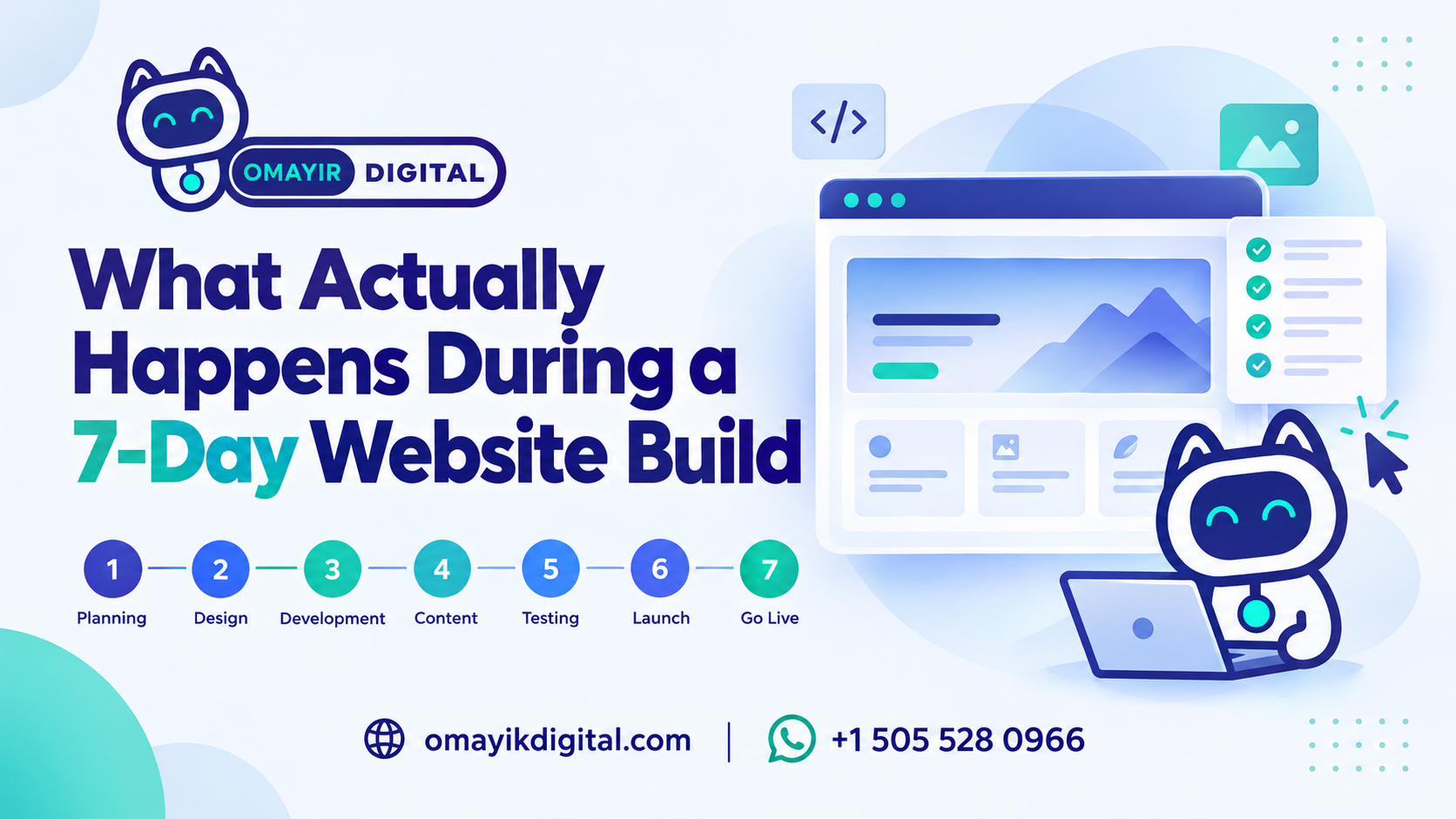
What Actually Happens During a 7-Day Website Build
Seven days sounds fast. Here’s exactly what happened at that time.
If you run a business, you’ve probably heard agencies quote 8 to 12 weeks for a website. So when someone says “7 days,” it’s fair to think one of two things. Either it’s a rushed template with your logo dropped in, or it’s a promise that falls apart on day four.
I get that. This article walks through each day of a real 7-day build at Omayik Digital, what gets done, what we need from you, and where the time actually comes from. You can decide for yourself if it holds up.
Why a website usually takes 8 to 12 weeks
Most websites are slow for boring reasons, not hard ones.
- Feedback sits in someone’s inbox for four days.
- Content gets written after the design, so the design has to change.
- Three people give three different opinions on the homepage.
- Nobody owns the project, so it drifts.
The actual design and build work is a small part of the timeline. The rest is waiting. A 7-day build removes the waiting. It doesn’t remove the work.
That’s the core idea: speed comes from a tight, repeatable process, not from skipping steps. Every step below still happens. It just happens in order, with no gaps between them.
Day 1: Discovery
We start with a kickoff call. It usually runs 45 to 60 minutes.
We ask things like:
- What does your business sell, and who buys it?
- What should a visitor do on the site? Call, book, buy, fill a form?
- Who are your competitors, and what do you like or dislike about their sites?
- Which sites do you like the look of?
- Do you already have a logo, brand colors, photos, and a domain?
By the end of day 1, we write a one-page brief. It lists your goal, your audience, the pages you need, and the single action you want visitors to take. You approve it before we move on.
Common mistake: trying to make the site do five jobs. A site that tries to sell, recruit, educate, and entertain usually does none of it well. Pick one main goal.
Day 2: Structure
Now we plan the skeleton of the site before anything looks pretty.
We map out the sitemap (which pages exist) and a wireframe for each key page. A wireframe is a simple grey-box layout that shows where the headline, text, images, and buttons go.
For a typical small business site, that’s 5 to 7 pages: Home, About, Services, one or two supporting pages, and Contact.
Here’s why this day matters. Changing a grey box takes two minutes. Changing a finished design takes hours. Most “this took forever” stories come from people skipping this step.
What we need from you: a yes or no on the sitemap within the day. Not a rewrite, just a decision.
Day 3: Content
This is the day that makes or breaks a fast build, and it’s the one clients often underestimate.
A website is words and images. If the words aren’t ready, nothing else can be final.
We write or edit the page copy based on the brief, using plain language and a clear call to action on every page. You send us what you already have: photos, service lists, prices, testimonials, your story. If you don’t have professional photos, we help you pick good stock images and tell you honestly which pages would be better with your own.
Practical tip: collect your content before the project starts. Even rough notes on your phone help. Businesses that arrive with photos and a service list almost always finish earlier.
Common mistake: writing “we are a passionate team dedicated to excellence.” Visitors skim past that. Say what you do, who it’s for, and what happens when they contact you.
Day 4: Design
Now the site gets its look.
We take your brand colors, fonts, and logo and apply them to the wireframes from day 2, with the real copy from day 3. Because the structure and words are already settled, design is mostly about spacing, hierarchy, and making it feel like your business.
You see the homepage design first. Then the inner pages follow the same system. We ask for one consolidated round of feedback, from one person or one shared list.
Why one round matters: design feedback is where timelines slip. Five separate opinions across five days can easily turn 7 days into 3 weeks. If you have partners or a team, agree on who gives the final word before we start.
Day 5: Build
This is where the design becomes a working website.
Depending on your needs, we build on WordPress, Shopify, or custom code. If you’re not sure which fits, our guide on WordPress vs Shopify explains the difference, and you can see how we work on each through our WordPress development, Shopify development, and custom web development pages.
During the build we:
- Set up the pages, menus, and forms
- Make it work properly on phones, tablets, and desktops
- Add basic SEO settings: page titles, descriptions, image names, and clean URLs
- Connect contact forms, booking tools, or WhatsApp buttons
- Set up hosting and your domain (if you need help choosing hosting, see this comparison of Hostinger, Bluehost, and GoDaddy)
Because we reuse tested building blocks for things like menus, forms, and mobile layouts, we aren’t reinventing the basics every time. That’s a big part of where the speed comes from. The building blocks are reused. Your design, copy, and goals are not.
Day 6: Testing
A fast site that breaks is worse than a slow site that works. So day 6 is just for testing.
We check:
- Devices: iPhone, Android, tablet, laptop, large monitor
- Browsers: Chrome, Safari, Firefox, Edge
- Forms: do submissions actually arrive in your inbox, and does the visitor see a thank-you message?
- Links and buttons: every one, on every page
- Speed: images compressed, pages loading quickly
- Content: typos, wrong phone numbers, missing alt text
Then you get a chance to review the site on a private link. You’ll probably spot small things, like a price that changed or a photo you’d rather swap. We fix them the same day.
Common mistake: testing only on your own laptop. Most visitors will see your site on a phone first, so we treat mobile as the main version, not an afterthought.
Day 7: Launch
Launch day is quieter than people expect, because the hard parts are already done.
We:
- Do a final check of the live-ready site
- Point your domain to the site and switch on SSL (the padlock in the browser)
- Submit the sitemap to Google Search Console
- Test the contact form and booking flow one more time on the live site
- Hand over your logins and a short guide on how to edit text and images
After launch we stay close for the first few days. Real visitors find things a test never will, and we’d rather fix them quickly than leave you to deal with it.
Real example: Marco T.’s restaurant site
Marco T. runs a restaurant. His old site was a one-page PDF menu that was hard to read on a phone, and there was no easy way to book a table.
We built him a new site in 5 days, not 7. A restaurant site is small and focused: menu, hours, location, photos, and a booking inquiry form. So some of our steps overlapped, and Marco sent his photos and menu on day 1, which saved us a full day on content.
Right after launch, he started getting booking inquiries through the site.
That’s the pattern. When the goal is clear, the content is ready, and feedback is fast, a small site really can go live in under a week. And it’s built for the one thing the business needs, which is people getting in touch.
Where the 7 days can slip
We’re honest about this because it helps you plan.
- Late content. If photos and text arrive on day 5, the site goes live later. Simple as that.
- Slow feedback. Every day a decision sits unanswered is a day added to the schedule.
- Scope changes mid-build. Adding a new section on day 5 means redoing earlier work. We’ll tell you what that does to the timeline.
- Multiple decision-makers. One person with final say is the biggest time-saver there is.
- Domain or hosting access. Hunting for a login from three years ago can eat a day.
If you can give us fast answers and your content, 7 days is realistic. If you can’t, we’ll tell you up front, not on day 6.
Is a 7-day build right for you?
It’s a good fit if you:
- Need a business website, a service site, a portfolio, or a focused landing page
- Have a clear idea of what you offer
- Can answer questions within a day
- Want a site that works well and can grow later
It’s probably not the right fit if you need:
- A large online store with hundreds of products and complex rules
- A custom web application with logins, dashboards, or payment flows
- A full redesign of a site with hundreds of pages
Those projects need more time, and a good agency will say so. If your project is bigger, our custom web development team can scope it properly, and our web development page shows the full range of what we build.
What about cost?
Speed doesn’t have to mean a bigger price tag, because less waiting means less project management time. Pricing depends on the number of pages and features. For a realistic range, read our breakdown of how much a business website costs, see the pricing plans, or look at web development costs in 2026.
If you’re weighing a do-it-yourself builder against hiring a team, this comparison of DIY vs a web agency lays out the real trade-offs. And if you’re still deciding what kind of site you need, the small business web design guide is a good place to start.
Quick checklist before we start
Having these ready helps us move quickly:
- Your logo and brand colors (or we help you pick simple ones)
- A short list of your services or products
- 5 to 10 good photos, or permission to use quality stock images
- Your domain name and hosting login, if you already have them
- Two or three websites you like
- One person who gives final approval
See how we work
Want to know what the end result looks like? Browse our portfolio and read more about our process.
Frequently asked questions
Can a good website really be built in 7 days? Yes, for the right kind of project. Small business sites, service sites, and landing pages are well suited. The time comes from a repeatable process and fast decisions, not from cutting steps.
What if I need changes after launch? Small fixes are normal and expected. Once you’re live, we can adjust text, images, and layout. Larger additions, like a new section or a booking system, can be planned as a next step.
Will I own the website? That’s something to confirm in writing with any agency. Ask about domain, hosting, and file ownership before you sign.
Will the site show up on Google? We set up the technical SEO basics at launch. Ranking takes longer and depends on your competition and ongoing content. A fast launch gets you indexed sooner, and our organic marketing service can help from there.
What if I’m not ready with my content? Tell us early. We can work with rough notes and help shape them, but the timeline depends on when we receive them.
Ready to see your site live this week? Let’s start.
Send us a quick message with your business name and what you want the site to do. We’ll reply with a clear plan and timeline.
- WhatsApp: +1 505 528 0966
- Contact page: omayikdigital.com/contact-us
Leave a Reply