
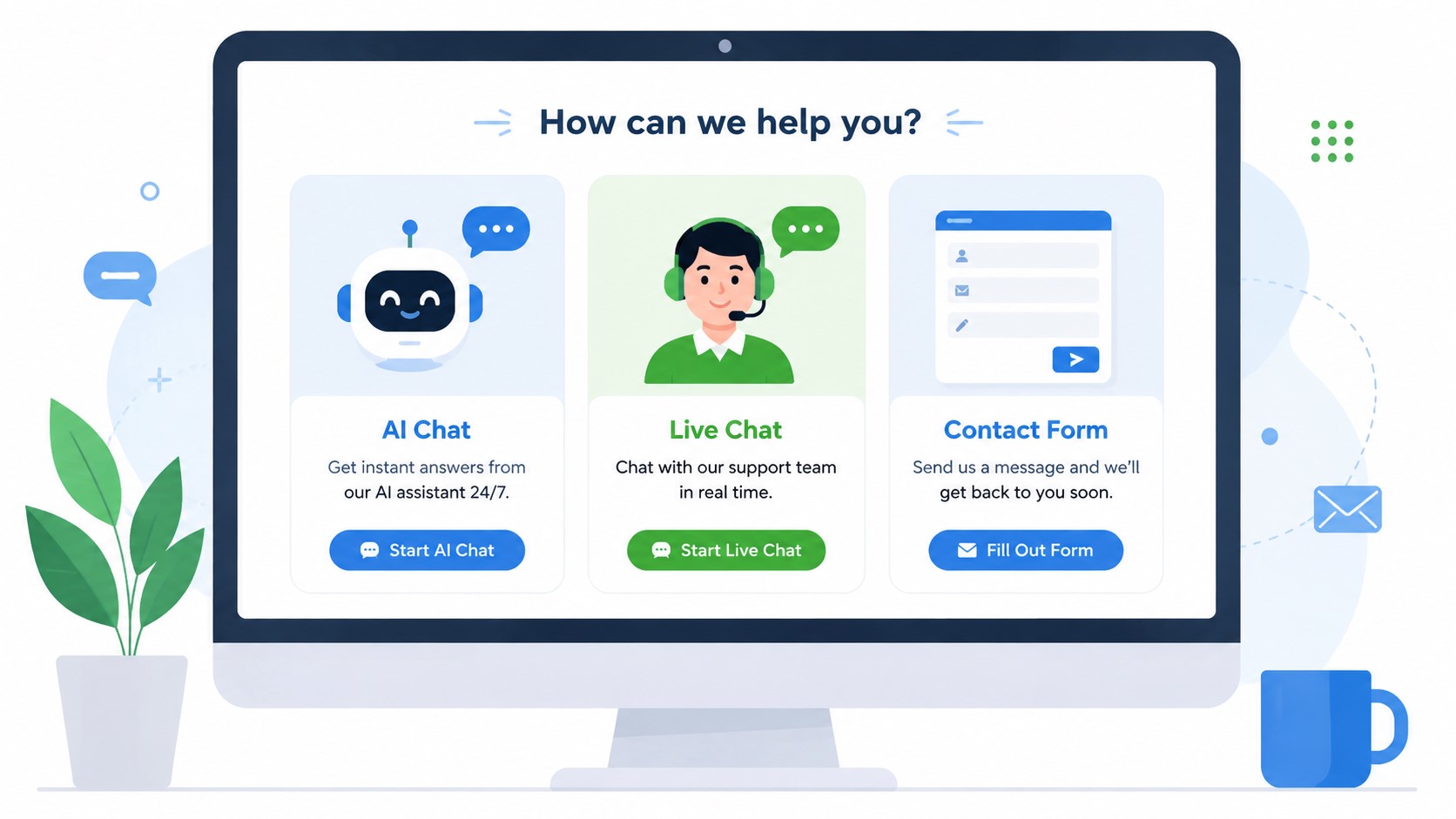
AI Chatbot vs Live Chat vs Contact Form: What Actually Converts Better for Small Businesses?
You put real money into getting people to your website. Google ads, social posts, SEO, word of mouth. Whatever it takes to bring visitors in.
Then they arrive. They look around. They have a question.
And most of them leave without ever telling you who they are.
That’s the part most small business owners don’t think about. The traffic problem gets all the attention. But the conversion problem (what happens after someone lands on your site) is often where the money actually goes to die.
The tool sitting on your website right now is either helping or hurting that number. This article breaks down the three most common options, shows you what the data actually says, and helps you figure out which one makes sense for your business.
The Three Options, Explained Simply
Before getting into the numbers, let’s make sure we’re talking about the same things.
Contact Form: A static form on your website. Name, email, message. The visitor fills it out, hits submit, and waits. You get an email notification and follow up whenever you can.
Live Chat: A chat widget that connects visitors to a real human on your team in real time. Someone has to be available to respond, or the widget goes offline.
AI Chatbot: A chat window powered by artificial intelligence. It answers questions automatically, 24 hours a day, 7 days a week. No human required. It can also qualify leads, book appointments, and collect contact details during the conversation.
Now let’s talk about what they actually do to your conversion rate.
The Numbers: What Converts Best
This is where it gets interesting.
Contact Forms
Contact forms are the most common tool on small business websites. They’re also the worst-performing one.
The average contact form on a small business website converts somewhere between 1% and 3% of visitors. That means for every 100 people who visit your site, 97 leave without leaving their information.
And it gets worse. Studies from Formstack show that even among people who do fill out a form, around 40% to 60% provide inaccurate contact info. So your real effective conversion rate from a contact form can fall below 2% of total traffic.
There’s also the response time problem. Most small business owners don’t reply to form submissions within the same hour. Research published through Harvard Business Review found that responding within 5 minutes makes a business 21 times more likely to qualify a lead compared to waiting 30 minutes. Most contact form submissions don’t get a response for hours, sometimes days.
By then, the visitor found someone else.
Live Chat
Live chat performs significantly better than contact forms. Businesses that add live chat to their website see an average 20% increase in conversions. Visitors who engage in live chat are about 2.8 times more likely to buy or inquire than visitors who don’t chat.
The customer satisfaction numbers are also strong. Around 82% of customers rate their live chat experience as positive, compared to 61% for email and 44% for phone support.
So what’s the catch?
You have to be there.
Live chat requires someone on your team to be available and responsive. The average response time that customers expect is under 2 minutes. If no one’s available, the widget either goes offline or the visitor waits indefinitely. Either way, you’ve lost the moment.
For a small business owner who’s also the person answering phones, managing jobs, handling billing, and dealing with everything else, being consistently available for live chat is genuinely hard. Most small businesses that set up live chat end up going offline for significant chunks of the day.
When it’s on and working, live chat is great. When it’s off or slow, it’s worse than a contact form because the visitor expected help and got nothing.
AI Chatbot
This is where the numbers get hard to ignore.
AI chatbots convert at 10% to 15% of website visitors on the same pages where contact forms convert at 1% to 3%. That’s a 3x to 5x difference using the exact same traffic.
Data from the 2025 State of Conversational Marketing report (HubSpot and Drift) found that chatbots engage 15% to 25% of website visitors who interact with them, with lead capture rates of 10% to 15% among engaged visitors.
One study analyzing nearly 5 billion website visits found that businesses using chatbots handled 89.2% of customer inquiries successfully, compared to just 71.2% for businesses without them.
Perhaps the most important number: 35% of chatbot conversions happen outside business hours. That means more than a third of the leads an AI chatbot captures would have been completely missed by a live chat setup or a contact form.
Side-by-Side Comparison
| Contact Form | Live Chat | AI Chatbot | |
|---|---|---|---|
| Conversion Rate | 1–3% | 10–20% (when staffed) | 10–15% (24/7) |
| Availability | Always visible | Only when staffed | 24/7/365 |
| Response Speed | Hours or days | Under 2 minutes (when online) | Instant |
| Lead Qualification | None (raw info only) | Depends on agent skill | Automatic |
| After-Hours Leads | Form sits idle | Chat goes offline | Captured automatically |
| Cost to Run | Low | Medium–High (staff time) | Low–Medium (setup cost) |
| Best For | Low-traffic, simple sites | High-volume, well-staffed teams | Most small businesses |
Why Chatbots Beat Forms (It’s Not Just the Tech)
There’s a psychological reason chatbots outperform forms, and it’s worth understanding.
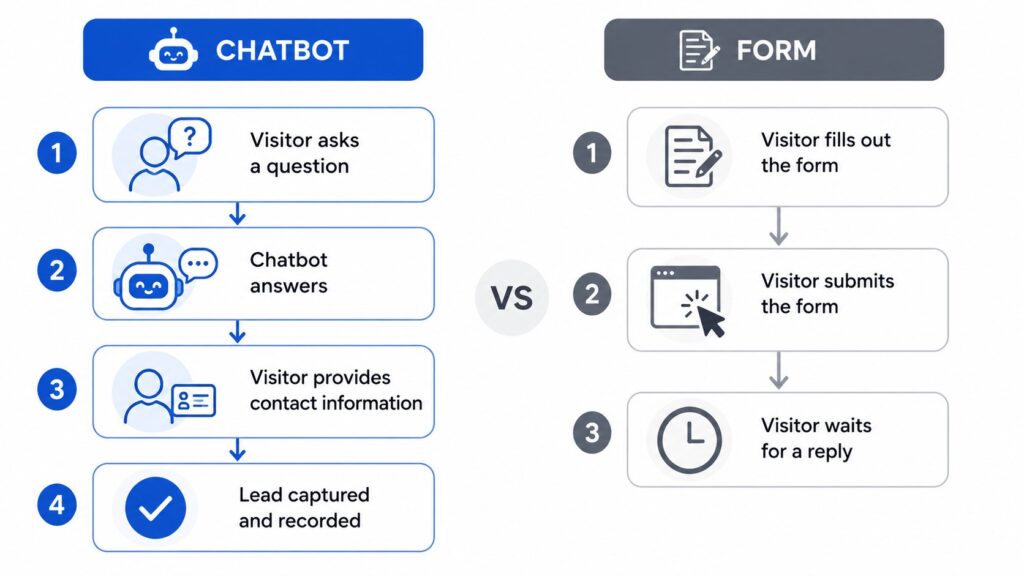
When someone fills out a contact form, they’re doing all the work upfront. They type their name, email, their question, hit submit, and then wait. They’ve given you everything and gotten nothing back yet. That’s a cold transaction that feels like effort with no immediate reward.
When someone opens a chat window, they’re starting a conversation. They ask a question. They get an answer right now. By the time the chatbot asks for their name or email, the visitor has already gotten value from the interaction. They’re not filling out a form. They’re continuing a conversation.
That shift in sequence changes everything.
When Live Chat Still Makes Sense
AI chatbots win on availability and consistency, but live chat has a real advantage in one situation: complex, high-value conversations.
If your business sells something that requires nuanced back-and-forth, like a custom quote, a specific technical question, or a service with a lot of variables, a trained human can close that conversation better than an AI right now. Visitors who connect with a real person in a complex situation are more likely to move forward.
The smart play for many businesses is a combination: an AI chatbot handles the routine questions and lead capture around the clock, and passes to a human when the conversation gets complex or high-value.
That way you’re not leaving money on the table after hours, and you’re still bringing the human touch to the moments that need it most.
What This Means for Your Specific Business
Not every business should do the same thing. Here’s a simple decision guide.
Use a contact form as a backup, not a primary lead capture tool. Every business should have one — but it shouldn’t be your main conversion mechanism.
Add live chat if you have the staff to support it consistently. If you can guarantee someone is available and responsive during business hours, live chat will lift your conversion rate. If you can’t, it may actually hurt trust when visitors see an “offline” message.
Consider an AI chatbot if you’re getting traffic but not enough leads. This is the most common situation for small business owners. Traffic is coming in, the contact form is sitting there, and most visitors leave without engaging. An AI chatbot captures those moments automatically.
A hybrid setup — AI for after hours, human for complex inquiries — is often the best long-term play.
The Hosting Connection (If You’re Setting This Up on WordPress)
If you’re running your business on WordPress (and most small businesses should be), setting up an AI chatbot is a plugin or integration away. Tools like Tidio, Chatbase, and Intercom all plug directly into WordPress sites.
You’ll want your hosting to be fast enough to handle the added script without slowing your site down. Slow loading kills conversions before the chatbot even has a chance to open. If you’re not on a solid host, that’s worth fixing first.
Hostinger offers WordPress hosting starting under $5/month with solid load speeds,
and it’s a simple place to start: 👉 Hostinger WordPress Hosting
The Done-For-You Option
If you’d rather not figure out which chatbot tool to use, how to configure it, how to train it on your business, and how to connect it to your CRM, that’s exactly what agencies like Omayik Digital do.
The setup matters a lot. A chatbot with bad scripting, slow responses, or irrelevant answers will actually hurt your conversion rate. Getting it right the first time is worth more than experimenting for three months.
FAQ
Does a contact form still make sense in 2026?
Yes, but as a backup or secondary option, not as your primary lead capture tool. It’s useful for visitors who prefer to fill out forms on their own time, but it shouldn’t be the only way people can reach you.
How much does an AI chatbot cost to set up?
Basic chatbot tools start free (like Tidio’s free tier) and go up from there depending on volume and features. A professionally configured chatbot built around your specific business and services costs more upfront but typically pays back quickly in captured leads.
Can a small business actually maintain live chat?
Some can. It depends on your team size and how much inbound traffic you get. If you’re a solo operator or have one or two employees focused on delivery, maintaining live chat availability consistently is genuinely hard. That’s why AI chatbots are popular with small businesses — they don’t need a person watching the screen.
What’s the fastest way to see results?
Adding a well-configured AI chatbot to an existing website with decent traffic is one of the faster ways to increase lead volume without spending more on ads. The traffic is already there. The chatbot just catches more of it.
Does my chatbot need to be industry-specific?
The more your chatbot is trained on your specific business (your services, your prices, your FAQs, your service area), the better it converts. Generic chatbots that don’t know your business give generic answers. That doesn’t build trust.
Bottom Line
Contact forms lose leads passively. Live chat captures leads actively but needs people to run it. AI chatbots capture leads around the clock without requiring staff.
For most small businesses with limited time and growing traffic, an AI chatbot gives you the biggest return for the effort. The data backs it up: 3x to 5x conversion rates compared to a contact form, with leads coming in at 2am when your contact form is just sitting there doing nothing.
If you want help figuring out the right setup for your business, or want someone to build and configure it for you, Omayik Digital works with small business owners across the US on exactly this. See our services here.
Leave a Reply