
Best Web Development Frameworks in 2026: A Complete Comparison
If you’re trying to figure out which framework fits your project, here’s the short version: there’s no single “best” framework in 2026, but there are clear right answers once you know what you’re building. React and Next.js remain the safest default for most teams because of hiring pool and ecosystem depth. Astro has become the standout choice for content-heavy sites like blogs and marketing pages. Vue and Svelte are strong picks when developer experience and simplicity matter more than raw ecosystem size. Angular still holds enterprise ground where structure and long-term support are non-negotiable.
That’s the answer in a sentence. The rest of this guide walks through why, and helps you figure out where your own project actually lands.
What “framework” actually means (and why it matters for your decision)
Before comparing options, it helps to get the terminology straight, because “framework” gets used loosely and that looseness causes real confusion when you’re hiring or briefing a developer.
A frontend framework (React, Vue, Svelte, Angular) handles what happens in the browser: rendering components, managing state, updating the interface when data changes. On its own, a frontend framework doesn’t know how to talk to a server or generate pages ahead of time.
A meta-framework (Next.js, Nuxt, SvelteKit, Remix, Astro) wraps a frontend framework with the extra plumbing needed to ship a real website: routing, server-side rendering, data fetching, deployment tooling. When people say “I built this in Next.js,” they usually mean React plus all of that extra scaffolding.
A backend framework (Express, Django, Laravel, Rails) runs on the server and handles things the browser never sees: databases, authentication, business logic, APIs.
Most business websites today are built with a meta-framework, not a bare frontend framework. That distinction matters because a lot of “which framework is best” debates are actually comparing things at different layers.
The current landscape, in plain terms
Multiple developer surveys converge on a similar picture for 2026. React remains the most widely used frontend option, sitting somewhere in the 40-47% range of professional developers depending on which survey you check (Stack Overflow’s 2025 Developer Survey and the State of JS 2025 report both put it well ahead of any single competitor). Angular and Vue trade places for second and third depending on the survey, generally in the 17-20% range each. Svelte sits lower in raw usage but consistently ranks as one of the most “admired” frameworks among developers who’ve actually used it, which tells you something different: satisfaction and adoption aren’t the same metric, and both matter depending on what you’re optimizing for.
None of that means React is automatically the right choice for your site. Popularity mostly tells you two things: how easy it will be to hire for, and how much community support and tooling you’ll have access to. It doesn’t tell you whether a framework is the best technical fit for a five-page brochure site versus a logged-in SaaS dashboard, which are genuinely different problems.
One development worth knowing about if you’re researching this topic: in January 2026, Cloudflare acquired the team behind Astro, the framework built specifically for content-driven sites. Astro stays open-source and platform-agnostic, but the acquisition signals that a major infrastructure company is betting seriously on the “fast, mostly static, content-first” approach to building websites, which is relevant if you’re choosing between an app-style framework and a content-style one.
Rendering approach: the decision that actually drives everything else
This is the part that gets glossed over in most “top 10 frameworks” listicles, but it’s the single most important technical decision behind any framework choice.
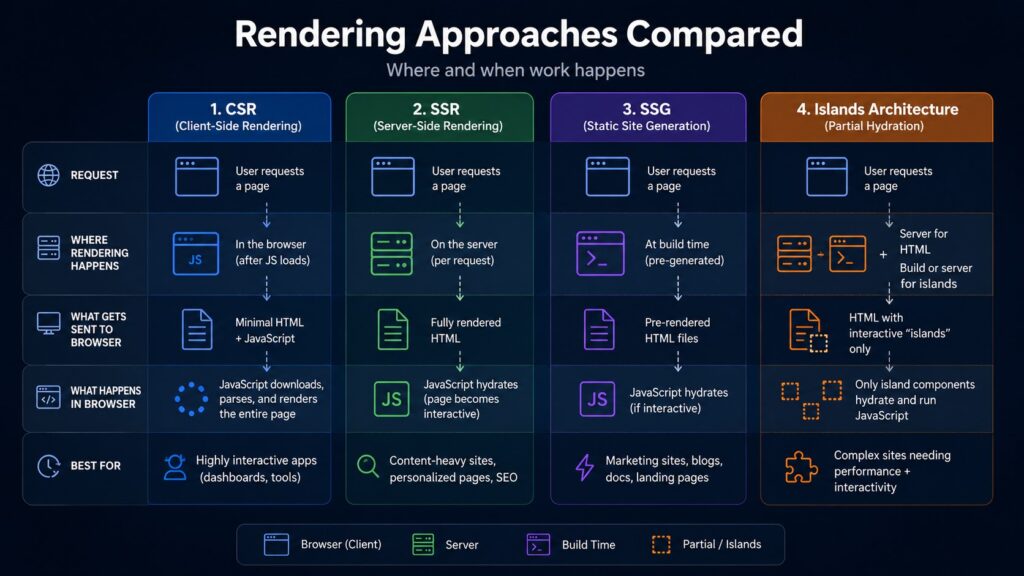
Client-side rendering (CSR) sends a mostly-empty HTML page to the browser, then JavaScript builds the page after it loads. This was the default approach for early React and Vue single-page apps. It works well for logged-in, app-like experiences but tends to hurt initial load speed and can complicate SEO because search engines have to execute JavaScript to see your content.
Server-side rendering (SSR) generates the full HTML on the server for each request, then sends a complete page to the browser. This is generally better for SEO and initial load performance, at the cost of needing a server running at all times to handle those requests.
Static site generation (SSG) builds every page in advance, at deploy time, so the server just serves pre-built HTML files. This is the fastest possible approach for content that doesn’t change per-visitor, and it’s why documentation sites, blogs, and marketing pages lean this direction.
Islands architecture, popularized by Astro, takes a different approach entirely: ship mostly static HTML by default, and only load JavaScript for the specific interactive pieces of a page that actually need it (a contact form, an image carousel, a cart icon). Everything else stays as plain HTML. The practical effect is that a typical Astro blog post can ship zero JavaScript, while the same page built as a default Next.js app might ship 80KB or more of JavaScript the visitor didn’t need just to read an article.
Why this matters for you: if you’re building a marketing site, blog, or brochure site, a framework or rendering approach optimized for content will almost always outperform an app-style framework on load speed and, by extension, on Core Web Vitals and search visibility. If you’re building a dashboard, an internal tool, or anything with heavy client-side interactivity and logged-in state, the calculus flips, and an app-focused framework like Next.js earns its complexity.
Framework comparison at a glance
| Framework | Best for | Rendering approach | Learning curve | Ecosystem maturity |
|---|---|---|---|---|
| React + Next.js | SaaS apps, dashboards, e-commerce, content sites that also need app-like features | SSR, SSG, and CSR, selectable per page | Moderate to steep (state management and the App Router add real complexity) | Very mature, largest talent pool |
| Vue + Nuxt | Teams that want a gentler learning curve without giving up SSR/SSG flexibility | SSR, SSG, hybrid | Gentle, especially for developers newer to component-based frameworks | Mature, strong outside North America especially |
| Svelte + SvelteKit | Performance-sensitive projects, teams that value simplicity and small bundle sizes | SSR, SSG, hybrid | Gentle, though the ecosystem is smaller so you’ll hit more DIY moments | Growing, smaller than React/Vue but well-regarded |
| Astro | Blogs, marketing sites, documentation, e-commerce catalogs, anything content-first | Static by default, islands for interactivity, SSR available when needed | Gentle if you know HTML/CSS; framework-agnostic if you want to mix in React or Vue components | Mature for content use cases, growing fast |
| Angular | Large enterprise applications, regulated industries, big teams that need enforced structure | CSR primarily, SSR available | Steep, most opinionated of the major options | Very mature, dominant in enterprise and government |
A simple decision framework
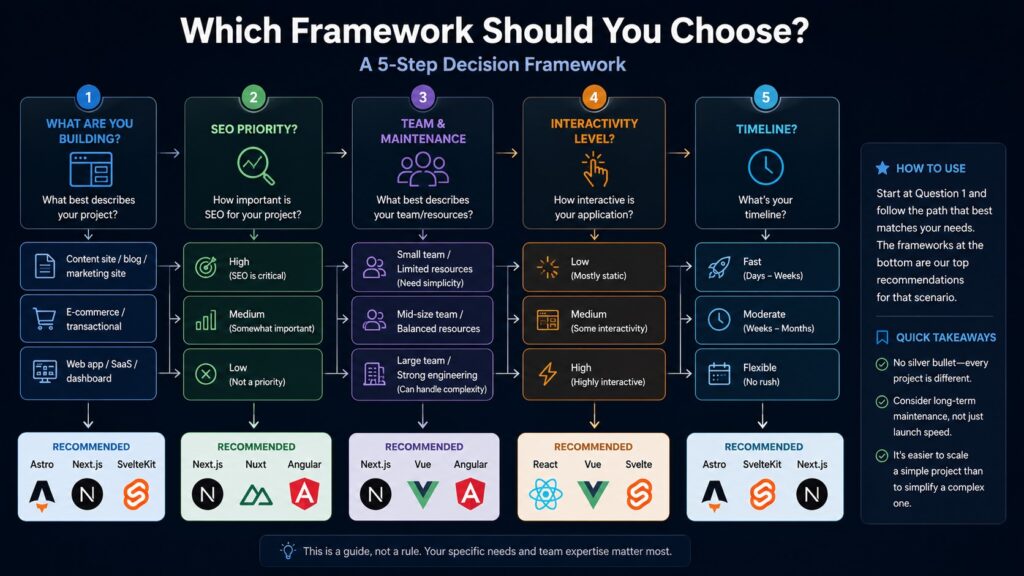
Instead of asking “what’s the best framework,” ask these questions about your actual project:
What are you building? A content-heavy site (blog, marketing pages, documentation, most small business websites) points toward Astro or a static-first approach. A logged-in application with lots of client-side interactivity (dashboards, internal tools, complex e-commerce with real-time cart state) points toward Next.js, Nuxt, or SvelteKit.
How much does SEO matter? If organic search traffic is central to the business, that’s a strong vote for anything that renders fast, clean HTML by default, which favors Astro or SSG-heavy setups over heavily client-rendered apps.
Who’s going to maintain this in two years? If you’re hiring developers or handing this off to an agency, React’s hiring pool is larger than any competitor’s by a wide margin. That’s not a technical argument, it’s a practical one, but it’s often the deciding factor for small businesses without an in-house dev team.
How complex is the interactivity? A five-page site with a contact form doesn’t need the same architecture as a dashboard with live data updates. Matching framework complexity to actual project complexity avoids both over-engineering and getting boxed in later.
What’s your timeline and budget? Frameworks with gentler learning curves (Vue, Astro) tend to get simple sites built faster if your team or agency isn’t already deep in React. Frameworks with bigger ecosystems (React) tend to have more prebuilt components and integrations, which can offset a steeper learning curve on larger projects.
Common mistakes businesses make when choosing a framework
Picking a framework because it’s trendy, not because it fits. A new framework that’s getting a lot of attention on social media isn’t automatically the right choice for a five-page business website. Popularity and fit are different questions.
Underestimating hosting and maintenance costs. Server-rendered apps generally need a server running continuously, which costs more and adds operational complexity compared to a static site that can be served from a CDN for a fraction of the price. This is a real, ongoing cost difference that rarely gets discussed until the first hosting bill arrives.
Over-engineering a simple site. Building a basic brochure or service site as a full single-page application with heavy client-side state management adds complexity and JavaScript weight for no real benefit, and it usually hurts load speed and SEO in the process.
Ignoring how rendering method affects search visibility. A site that relies heavily on client-side JavaScript to render its main content can still be indexed by modern search engines, but it’s a riskier bet than serving clean HTML upfront, and it can affect how quickly new content gets crawled and shown in results.
Assuming the framework decision is permanent. Migrating frameworks later is possible but expensive. That’s a reason to think carefully upfront, not a reason to freeze up: pick based on your actual current and near-term needs rather than trying to future-proof against every hypothetical.
If you’re not a developer: what to actually ask before hiring someone
If you’re a business owner evaluating quotes from developers or agencies, you don’t need to become technical to ask good questions. A few worth asking:
- “Why this framework for my specific project, not just in general?” A good answer references your actual use case (content-heavy vs. app-heavy, SEO priority, budget), not just “it’s what we always use.”
- “What will hosting cost on an ongoing basis?” Server-rendered setups typically cost more monthly than static ones. Get a real number, not a range.
- “How will this affect my page load speed and search rankings?” This is a fair, answerable question regardless of framework, and a developer who can’t address it plainly is worth a second look.
- “If I need to change developers or agencies later, how easy is it to find someone else who works in this stack?” This is really asking about the hiring pool question from above, and it protects you from being locked into one vendor.
This is exactly the kind of decision an agency makes on a client’s behalf as part of building the site, factoring in the project type, budget, and growth plans rather than defaulting to whatever’s trendiest that quarter.
A note on AI coding tools and framework choice
AI coding assistants like GitHub Copilot and Claude Code have become a standard part of many developers’ workflows in 2026, and they’re changing some of the calculus around framework choice, though the picture is more mixed than the more enthusiastic coverage suggests. Multiple 2026 studies report real productivity gains from AI-assisted coding, but reputable research, including DORA’s own reporting, has also found mixed effects on delivery stability and throughput when AI tools are adopted without solid guardrails. The honest takeaway: AI tools can meaningfully speed up boilerplate-heavy work in any framework, but they don’t change the fundamentals of which framework fits which project. A well-established framework with strong documentation (React, Vue, Astro) tends to get better results from AI coding tools simply because those tools have more training data and examples to draw from, which is a small but real point in favor of sticking with proven options over obscure ones.
The bottom line
For most small business websites, especially content-first sites like the ones a marketing-focused business runs, a static-first or islands-based approach (Astro, or an SSG-heavy setup) tends to win on speed, SEO, and hosting cost. For anything that needs real application-like behavior, logged-in dashboards, or complex client-side state, React with Next.js remains the safest, most hireable default. Vue and Svelte are excellent middle grounds when a team wants less complexity without sacrificing capability. Angular still earns its place in large, structured enterprise environments.
None of this is a values judgment on any framework. It’s a matching exercise between what you’re building and what each tool was actually designed to do well.
If you’d rather not make this call yourself, Omayik Digital handles exactly this kind of technical decision as part of building a site, matching the framework and hosting setup to what a project actually needs rather than defaulting to whatever’s trending. If you want a second opinion on a quote you’ve already received, or you’re starting from scratch and want the framework question handled for you, book a free discovery call and we’ll walk through what makes sense for your specific project.
Sources referenced in this article include the Stack Overflow Developer Survey 2025, the State of JS 2025 survey, Astro’s official documentation, and Cloudflare’s January 2026 announcement regarding its acquisition of the Astro Technology Company.
Leave a Reply