
Frontend vs Backend Development: What’s the Difference?
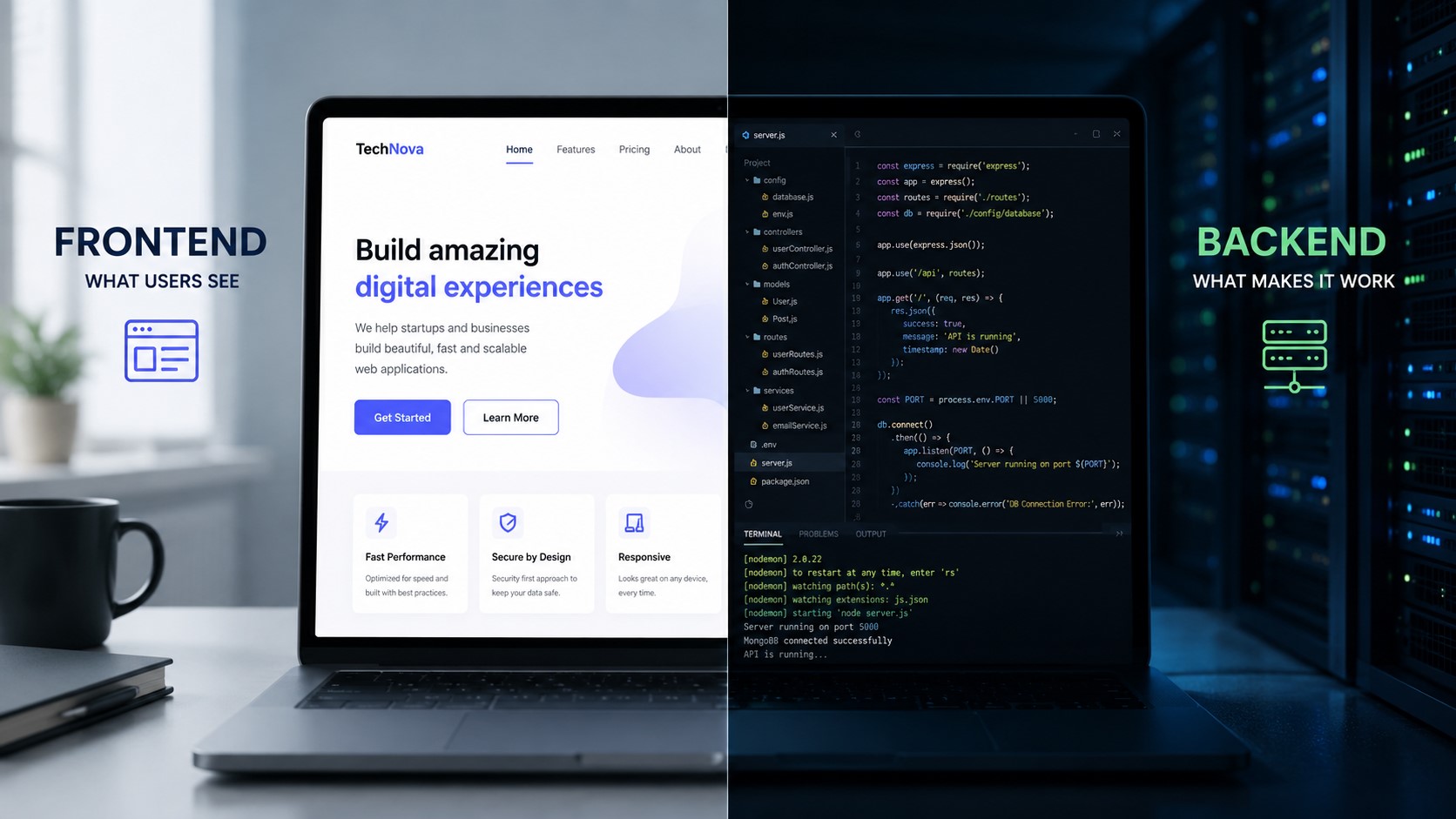
If you’ve gotten a quote from a developer or read a job posting and seen the words “frontend” and “backend” thrown around like everyone already knows what they mean, you’re not alone in feeling a little lost. Here’s the short version: frontend development is everything a visitor sees and clicks on in their browser. Backend development is everything happening behind the scenes that makes those clicks actually do something, like saving your order, checking your password, or pulling up a product page.
Both matter. Most websites need at least some of each. But depending on what you’re building, you might need a lot more of one than the other, and knowing the difference can save you from an awkward conversation with a developer (or a confusing invoice).
Contact Us: https://omayikdigital.com/contact-us/
What Is Frontend Development?
Frontend development is the part of a website or app you interact with directly. The layout, the colors, the buttons, the way a menu slides open when you tap it on your phone. If you can see it or click it, a frontend developer probably built it.
Frontend developers work with three core building blocks:
- HTML – structures the content (headings, paragraphs, images, buttons)
- CSS – handles the visual styling (colors, spacing, fonts, layout)
- JavaScript – adds interactivity (dropdown menus, form validation, animations)
Most frontend work today also involves a framework, like React, Vue.js, or Angular. These tools make it faster to build complex, interactive interfaces without writing everything from scratch every time.
A frontend developer’s job is largely about making sure the site looks right and behaves correctly across different devices and screen sizes. Does the layout hold up on a phone? Does the checkout button actually respond when clicked? Does the page load fast enough that people don’t bounce before it even finishes? That’s frontend territory.
Contact Us: https://omayikdigital.com/contact-us/
What Is Backend Development?
Backend development is what happens on the server, out of view, after a user does something on the frontend. When you fill out a contact form and hit submit, the frontend handles the button click and the little “Thanks, we got it!” message. The backend is what actually takes that form data, checks it, stores it somewhere, and maybe sends you an email notification.
Backend developers work with:
- Server-side languages like Python, PHP, Ruby, Java, or Node.js
- Databases like PostgreSQL, MySQL, or MongoDB, where information gets stored and retrieved
- APIs, which are basically the messengers that let the frontend and backend talk to each other
If your website needs user accounts, a shopping cart, a booking system, or anything that has to remember information between visits, that logic lives on the backend. It’s less visible, but it’s often where the real complexity of a project sits.
Frontend vs Backend: A Quick Comparison
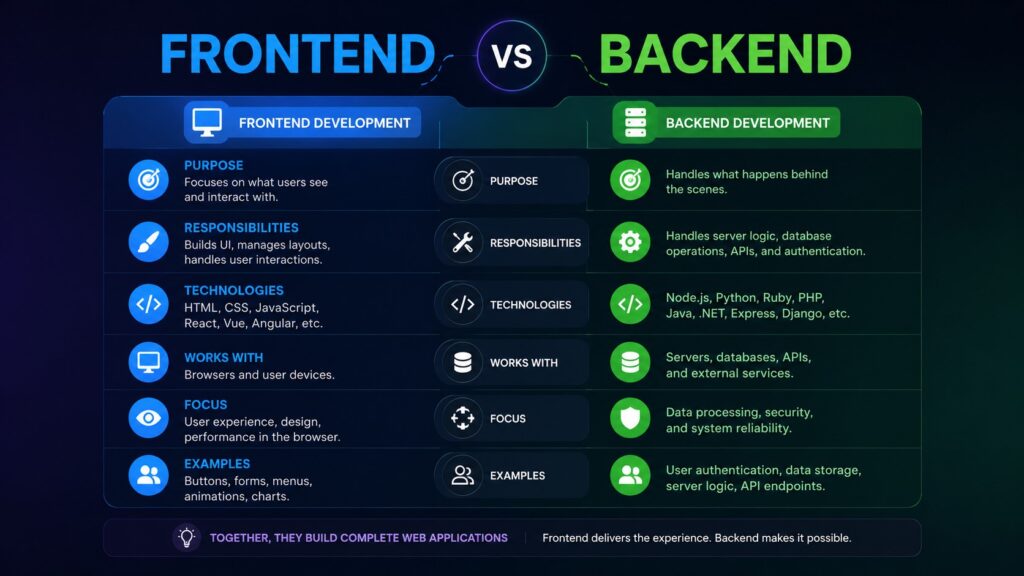
| Frontend | Backend | |
|---|---|---|
| What it controls | What the user sees and interacts with | What happens behind the scenes |
| Common languages | HTML, CSS, JavaScript | Python, PHP, Java, Node.js, Ruby |
| Common frameworks | React, Vue.js, Angular | Django, Laravel, Express, Ruby on Rails |
| Runs where | In the user’s browser | On a server |
| Handles | Layout, styling, interactivity, responsiveness | Databases, business logic, authentication, APIs |
| Example task | Making a button change color on hover | Verifying a login password against a database |
| Visible to the user? | Yes, directly | No, works invisibly in the background |
Contact Us: https://omayikdigital.com/contact-us/
A Real-World Example: What Happens When You Click “Add to Cart”
This is probably the easiest way to see the split in action.
Say you’re shopping on an online store and you click “Add to Cart.” Here’s what’s actually happening:
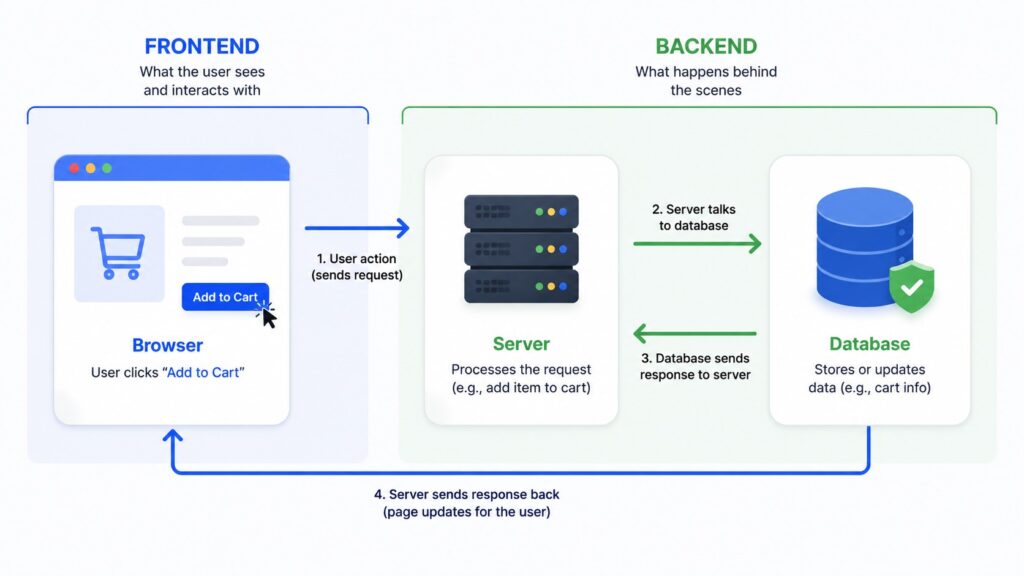
- Frontend: The button responds to your click. Maybe it animates, maybe the cart icon updates with a little number, maybe a confirmation message pops up. All of that is frontend work, it’s about giving you visual feedback that something happened.
- Backend: At the same time, a request gets sent to the server asking, “Does this product still have stock? What’s the current price? Which cart does this belong to?” The backend checks the database, updates the cart record, and sends confirmation back to the frontend, which is what triggers that visual update you see.
Neither side can really do its job without the other. The frontend without a backend is just a static page that looks nice but can’t actually process an order. The backend without a frontend is a bunch of working logic nobody can access because there’s no interface to use it.
Common Misconceptions Business Owners Run Into
“My site looks done, so the technical work must be done too.” Not necessarily. A site can look completely polished on the frontend while still needing significant backend work if it’s supposed to handle logins, payments, bookings, or any kind of data storage. A pretty homepage and a functioning system are two different projects.
“Frontend developers don’t deal with data at all.” They do, just not in the same way. Frontend developers regularly display and format data (like showing a product’s price or a user’s name) that the backend has already fetched or processed. They’re just not the ones deciding how that data gets stored or validated.
“I just need a website, so I only need frontend work.” This depends entirely on what the site needs to do. A simple portfolio or informational site might genuinely be frontend-only, or close to it. But the moment you add a contact form that emails you, a login system, or a way for customers to check order status, you’ve introduced backend requirements, even if the site still looks simple. This is usually where custom web application development enters the conversation, since that kind of project leans much more heavily on backend logic than a standard brochure-style site.
What About Full-Stack Development?
A full-stack developer works across both frontend and backend. Instead of specializing deeply in one side, they have working knowledge of both, and can build a complete feature from the interface down to the database.
Full-stack developers, or full-stack teams, tend to make sense for smaller projects where hiring separate specialists for each side isn’t practical or necessary. For larger, more complex builds, hiring dedicated developers for frontend and backend separately often makes more sense, since each side has enough depth to justify specialized focus. There’s no universally right answer here. It depends on the size and complexity of what you’re building, and honestly, on budget.
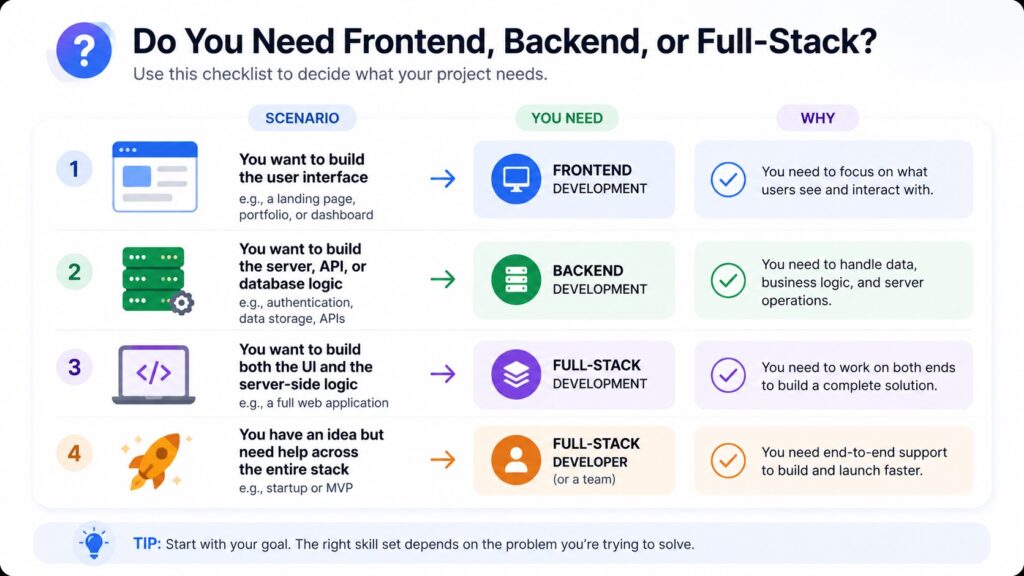
Do You Need Frontend, Backend, or Full-Stack?
A rough way to think about it:
- Mostly frontend: You need an informational site, portfolio, or landing page with no accounts, payments, or stored user data.
- Mostly backend-heavy: You’re building something data-intensive, like an internal tool or dashboard, where the interface is simple but the logic behind it is complex.
- Both, roughly equal: You need a site with e-commerce, user accounts, bookings, or any feature where users submit and retrieve information.
- Full-stack developer or small team: Your project is small-to-mid-sized and you’d rather work with one point of contact than coordinate two specialists.
If you’re not sure which category your project falls into, that’s a completely normal position to be in. It’s also exactly the kind of question worth sorting out with a developer before a project starts, rather than after you’ve already gotten a quote that may or may not match what you actually need.
Contact Us: https://omayikdigital.com/contact-us/
Getting the Right Fit for Your Project
The frontend/backend distinction matters most when you’re trying to scope a project or figure out why one quote is a lot higher than another. A site that’s “just frontend” is a fundamentally different build than one that needs backend infrastructure for logins, payments, or data storage, and the cost and timeline usually reflect that. If you’re comparing quotes right now and trying to make sense of the numbers, our breakdown of web design packages and pricing walks through what typically drives cost up or down. And if you’re still in the early stage of figuring out who to hire, how to hire a web developer covers the questions worth asking before you sign anything.
If you’re planning a new website and aren’t sure whether your project needs a straightforward frontend build or something with real backend functionality behind it, Omayik Digital offers a free discovery call to walk through exactly that. It’s a low-pressure way to figure out what you actually need before committing to anything. You can also browse past projects or check service options if you’d rather look around first.
Either way, understanding this one distinction puts you in a much better position to ask the right questions and know what you’re paying for.
Leave a Reply