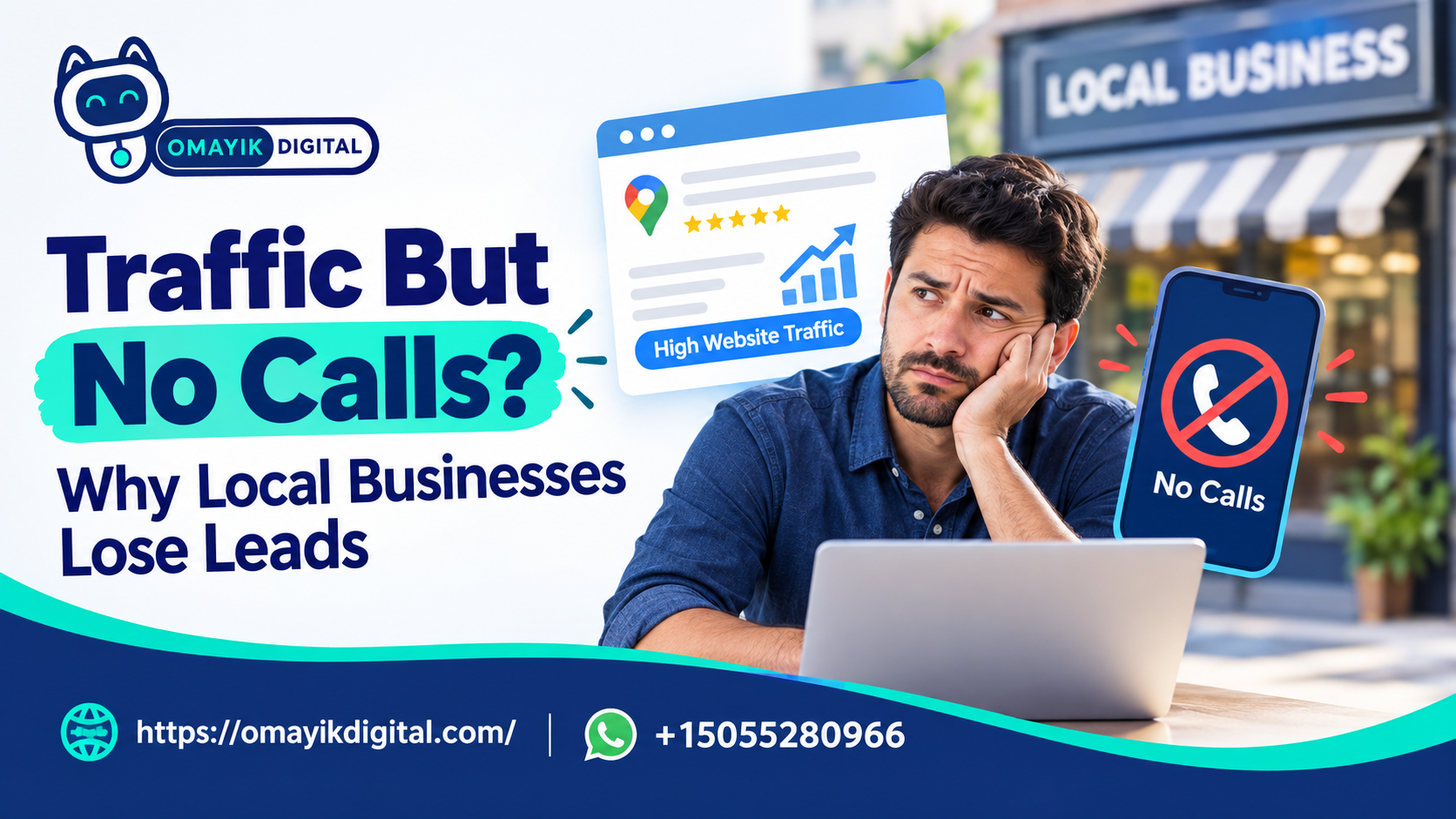
You’re Showing Up on Google. So Why Isn’t Anyone Calling?
You open your analytics. Visits are up. Google Business Profile says people found you. Maybe you’re even paying for ads.
Then you look at your phone. Nothing.
This is one of the most common problems we see with local service businesses. The marketing is doing part of its job. People can find you. But somewhere between “found you” and “called you,” they disappear.
The good news is that this is usually fixable, and it rarely needs a bigger budget. It needs you to find the leak. This guide walks you through where leads usually drop off, and what to check first.
Traffic Is Not the Same as Leads
Here’s the simple truth. Traffic is people looking. A lead is a person who raised their hand.
Analytics tools count visits. They don’t count the plumber’s customer who landed on your page, couldn’t find a phone number on their phone screen, and tapped back to the next result.
So a “good” traffic report can hide a bad result. If 500 people visit and 3 contact you, the problem is not visibility. The problem is what happens after the click.
Think of it like a shop with a busy sidewalk and a locked door. The foot traffic is real. It just doesn’t turn into sales.
Where Leads Actually Get Lost
Most local businesses lose people in four places. Check them in this order.
1. Your Google Business Profile is sending the wrong signals
For most local searches, your Google Business Profile is the first thing people see, not your website. If it’s weak, people scroll past or call your competitor instead.
Common problems:
- Wrong or old hours. A customer calls at 6 pm, your profile says you’re open, and nobody answers. That’s a lost customer and often a bad review.
- Wrong phone number or a number that goes to a dead line. It happens more than you’d think, especially after a business moves or changes providers.
- Wrong categories. If you’re a deep cleaning company listed only as “house cleaning service,” you’ll show up for the wrong searches.
- Few photos, or photos that look old. People judge a local business in seconds. Real photos of your team, your work, and your location build trust fast.
- No recent reviews, or reviews you never answer. A profile with a gap of many months looks inactive.
- No booking or website link, or a link that goes to your homepage instead of the page that matches the service.
A quick test: search for your own business name on your phone, then search for your main service plus your city. Tap every button on your own profile. Does the call button work? Does the website link land somewhere useful?
2. Your website doesn’t tell people what to do next
A lot of local sites look nice but never ask for anything. Visitors read a bit, think “okay,” and leave.
Check your site on a phone, because that’s where most local searches happen. Ask yourself:
- Can I see a phone number or a “Call now” button without scrolling or hunting?
- Is there one clear action on each page, or five competing ones?
- Is the form short? A form that asks for ten details to get a quote will lose people. Name, phone, and what they need is usually enough.
- Does the page answer the questions people have before they call? Price range, service area, how fast you can come, and what happens next.
A “Contact us” link buried in the menu is not a call to action. A big button that says “Get a free quote today” or “Call us now” near the top of the page is.
If your pages are slow, cluttered, or built for a desktop screen first, fixing that can change results more than any new ad. Our guide on small business web design covers what a page needs to turn visitors into inquiries. If you’re sending ad traffic to a general page, a focused landing page built around one offer usually does better.
3. Your traffic is the wrong kind
Sometimes the page is fine and the visitors are the problem.
If you rank for broad or loosely related searches, you’ll get visits from people who were never going to hire you. Think of a roofer ranking for “how to fix a leaking roof yourself.” Great traffic number, zero jobs.
Look at the search terms bringing people in (Google Search Console shows this for free). You want searches with buying intent, like “emergency plumber near me,” “tile cleaning quote,” or “hair salon open Sunday.” If most of your visits come from “how to” and “what is” searches, you’re attracting readers, not customers.
This is also true for paid ads. Broad keywords and a wide location can eat your budget on clicks that never call. Tighter keywords, a smaller service area, and ad text that includes your real price range or offer help filter out the wrong people. If you’re not sure whether your setup is helping or hurting, our paid marketing and organic marketing pages explain how we approach each one.
4. Nobody catches the lead and follows up
This is the leak most owners never see, and it’s often the biggest one.
People don’t always call the moment they visit. They fill out a form, send a message, or call and get no answer. If nothing happens quickly after that, they move on. Lead response studies keep showing the same pattern: the sooner you reply, the more likely you win the job. Waiting until tomorrow is often too late.
Let’s make this real.
A Real-World Example: The Restaurant and the Salon
The restaurant. A family restaurant gets plenty of Google traffic. Most people look at the menu and decide about dinner between 5 and 9 pm. Some want to book a table for a birthday on Saturday. They fill out the reservation form at 10:30 pm on Wednesday, after the kitchen has closed and the staff has gone home.
Nobody sees that form until Thursday afternoon. By then, the customer has booked somewhere else that confirmed right away. The restaurant never knew they lost a 12-person booking. Analytics just shows a “form submission,” which looks like a win.
The salon. A salon owner is with a client most of the day and can’t answer the phone with color on her hands. A new customer calls at lunch, gets voicemail, and doesn’t leave a message. Another one messages on Instagram at 9 pm asking for a Saturday appointment. The reply comes two days later: “Sorry, we’re booked.”
Neither business has a marketing problem. Both have a catching problem. The leads were there. Nothing was in place to answer them when the owner couldn’t.
This is common for any business where the people who do the work are the same people who answer the phone: salons, clinics, cleaners, plumbers, electricians, tutors, photographers, and repair shops.
What a simple catch-and-follow-up system looks like
You don’t need anything fancy. You need these basics:
- An instant reply. When someone fills out a form or sends a message, they get a text or email within a minute. Something like: “Thanks for reaching out. We got your message and will confirm your booking by 10 am tomorrow. If it’s urgent, call or WhatsApp us here.”
- A missed call text-back. If a call goes unanswered, an automatic text goes out: “Sorry we missed you. What can we help with?” Many people will reply to a text even when they won’t leave a voicemail.
- After-hours coverage. A chatbot, auto-reply, or booking link that works at 10 pm. It doesn’t have to sound like a robot. It just has to answer the first question and hold the lead until you’re back.
- A reminder for you. Every new lead lands in one place (a shared inbox, a simple CRM, even a spreadsheet) with a note to follow up. If a lead hasn’t heard from a human in a few hours during business time, someone gets pinged.
- A second touch. A lot of sales happen on the second or third message, not the first. A simple follow-up two days later (“Still need help with this?”) brings back people who got busy.
If you’re not sure which tool fits, our comparison of an AI chatbot, live chat, and a contact form breaks down the pros and cons for small businesses.
A 15-Minute Self-Check
Before you spend more money on marketing, try this. It’s free and it’s eye-opening.
- Call your own business from a number that isn’t saved in your phone, at an odd hour. What happens?
- Fill out your own contact form at night. How long until you get a reply? Did you get any confirmation?
- Open your site on your phone. Can you find a way to contact you in five seconds?
- Check your Google Business Profile. Are hours, phone, categories, and links right?
- Look at your last 10 inquiries. How many got a reply within an hour? How many never got one?
- Open Search Console. Are the top searches the kind that lead to a booking?
Most owners find at least two problems in this list. Fix those before you change anything else.
Common Mistakes to Avoid
- Buying more traffic to fix a conversion problem. If the leak is after the click, more clicks just waste more money.
- Judging marketing by visits. Track calls, forms, bookings, and booked jobs instead.
- Using five different calls to action on one page. Pick one main action.
- Hiding your phone number because you don’t want to be “salesy.” Local customers want to call.
- Ignoring reviews. Reply to them, good and bad. It shows you’re active and it helps the next customer decide.
- Letting leads sit in an inbox. An unanswered lead is a lead for your competitor.
- Over-automating. Automation should catch and hold the lead, not replace a real conversation. People still want a human to confirm the job.
How to Know If It’s Working
Pick a few numbers and watch them each month:
- Calls from your Google Business Profile
- Form submissions and messages
- How fast you reply on average
- How many inquiries turn into booked jobs or visits
- Cost per lead, if you run ads
If visits go up and calls stay flat, you know the leak is still there. If calls go up with the same traffic, your fixes are working. Give changes a few weeks before you judge them, because local results take a little time to settle.
Where to Start
You don’t have to rebuild everything. Most local businesses get the biggest gain from three things: fixing the Google Business Profile basics, making the next step obvious on the website, and replying to every lead fast, even when you’re busy or closed.
Traffic only pays off when something is there to catch it. If your marketing is already bringing people in, you’re closer than you think.
If you’d like help seeing the whole picture, our digital marketing team looks at the full path from search to booked job. You can also see how we price our work.
Want a Quick Look at Where Your Leads Are Dropping Off?
Tell us about your business and we’ll take a look at your profile, your site, and your follow-up process. No pressure, no long pitch.
- Message us on WhatsApp: +1 505 528 0966
- Or reach out here: Contact Omayik Digital
FAQ
Why do I get website traffic but no phone calls? Usually the issue is after the click. The site may not show a clear next step, the Google Business Profile may have wrong details, the traffic may come from people who aren’t ready to buy, or leads may not get a fast reply.
How long should it take to reply to a new lead? As fast as you can. For most local services, within a few minutes during business hours is a good goal, and an instant automatic reply outside business hours.
Is a chatbot a good idea for a small local business? It can be, if it answers common questions, collects the customer’s details, and hands off to a real person. A bad chatbot that blocks people from reaching you does more harm than good.
Do I need new traffic, or better conversion? If you already get steady visits and few contacts, work on conversion first. It’s usually cheaper and faster than buying more traffic.
What should I check on my Google Business Profile first? Phone number, business hours, primary category, website link, photos, and whether you reply to reviews.
Leave a Reply