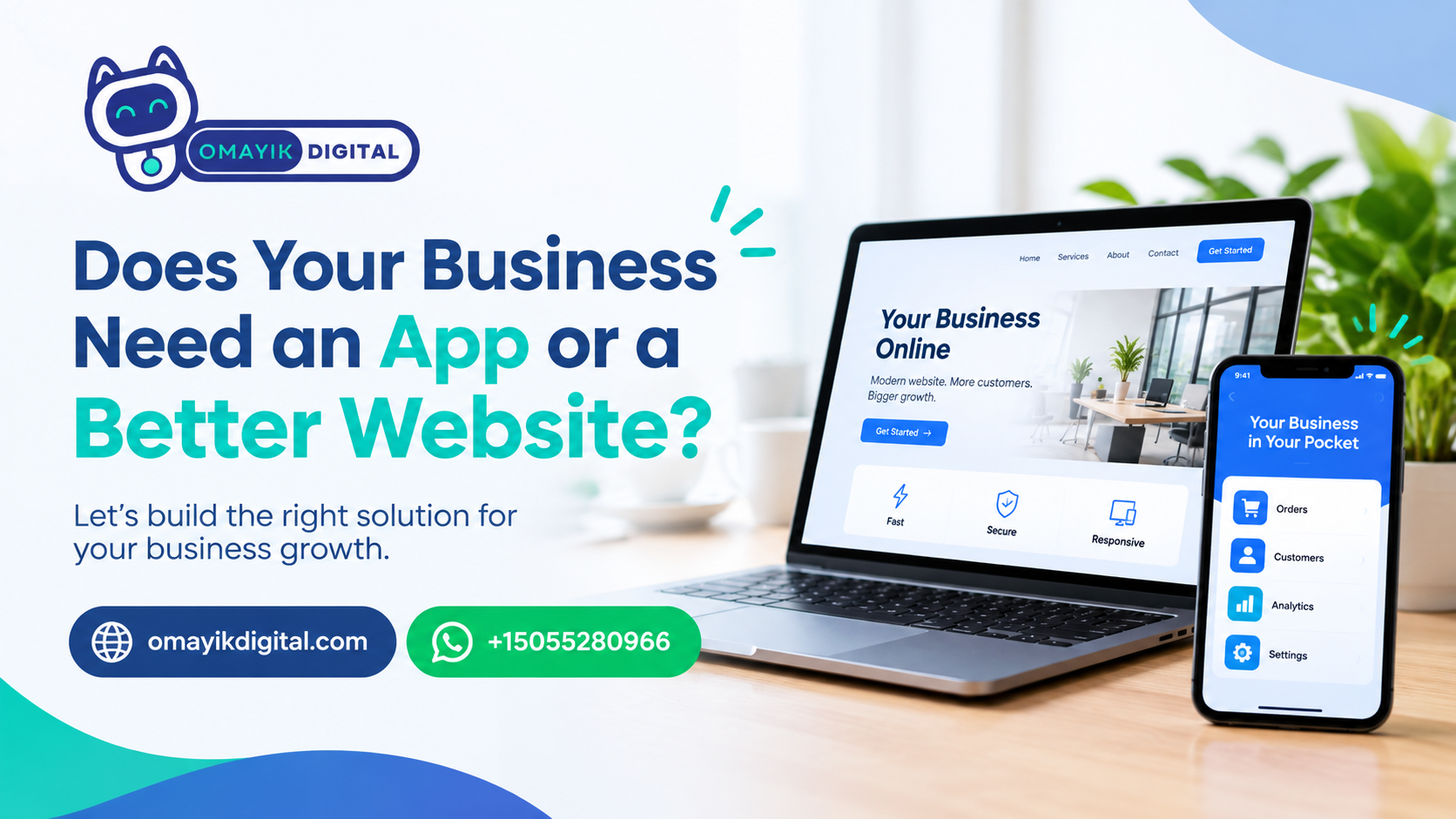
Does Your Business Actually Need an App, or Does It Need a Better Website?
Before you spend money on an app, ask this one question first: “Do people already know I exist?”
If the honest answer is “not really,” an app won’t fix that. If the answer is “yes, and they keep coming back,” an app might be worth it.
I hear the same story from business owners all the time. A competitor launches an app. It shows up in an ad or on a customer’s phone. Suddenly it feels like you’re falling behind. So you start asking for quotes.
Hold on for a minute. Having an app and needing an app are two different things. This guide will help you work out which one applies to you, before you spend anything.
The one idea that clears things up
An app is a retention tool. A website is a discovery tool.
Think about how a new customer finds you. They search on Google, ask a friend, or click a link on social media. Then they land on a web page. Almost nobody downloads an unknown app from a business they’ve never heard of. That’s a big ask for a stranger.
Now think about a customer who already loves you. They book every month. They want faster checkout, reminders, and maybe a loyalty reward. That person might happily install your app, because it makes their life a little easier.
So the order matters:
- People discover you (website, search, social, ads)
- They try you once
- They come back
- An app helps them come back more often
Most businesses are stuck at step 1 or 2. An app only helps at step 3 and 4.
Why a competitor having an app isn’t a good reason
It’s easy to copy what the other guy is doing. But you can’t see their numbers. You don’t know if their app has 50 users or 5,000. You don’t know if it makes them money or if it’s a quiet expense they regret.
Here are a few things to remember:
- Apps get built for many reasons that aren’t about customers. Sometimes it’s pride. Sometimes a developer pitched it. Sometimes it was a nice idea at a board meeting.
- Lots of apps get installed once and never opened again. Phone storage is crowded, and people delete things they don’t use.
- Their situation may be different from yours. A national chain with daily customers is in a different place than a local business with a few hundred clients.
Copy the result your competitor wants (more loyal customers), not the tool they chose to get it.
The decision framework
Run your business through these five questions. Be honest. Nobody is grading you.
1. How often do customers come back?
- Weekly or more: Gym, coffee shop, salon, food delivery, daily service. An app can make sense.
- Monthly: Maybe. It depends on the other questions.
- A few times a year or once: A website almost always wins. Nobody installs an app for something they use twice a year.
2. Do you need to reach customers on their phone, right now?
Push notifications are the biggest real advantage of an app. If a message like “Your slot is open tomorrow at 3 PM” or “Your order is on the way” directly makes you money, that’s a strong point for an app.
If you can get the same result with email, SMS, or WhatsApp, you probably don’t need an app for this.
3. Do you need phone features a website can’t use well?
Some things really do need a native app: heavy camera use, offline mode, Bluetooth devices, advanced location tracking, or smooth animations in something like a game. Modern websites can do a lot more than they used to, but there are still gaps.
If your list of “must-have features” is just a menu, a contact form, a gallery, and a booking button, that is website work.
4. Where do new customers come from today?
If most of your customers come from Google, Instagram, or referrals, your first job is making sure those people land on something that builds trust fast. That means a clear, quick, mobile-friendly website. An app doesn’t show up in search results the same way a web page does.
5. Can you afford to build it AND keep it running?
This is the one people skip. An app is not a one-time purchase. After launch you’ll deal with:
- Updates when iPhone and Android release new versions
- Bug fixes
- App store reviews and rules
- Two platforms to maintain (iOS and Android), unless you build one shared version
- Server and support costs
A website needs care too, but it’s usually lighter and cheaper to maintain.
A quick way to score yourself
Count how many of these are true for your business:
- Customers use my service every week or more
- I have a loyalty or rewards system that would work better in an app
- Push notifications would clearly bring in more revenue
- I need features like offline mode or deep phone hardware access
- I already have a steady stream of customers and a decent website
4 or 5 yes answers: An app is worth a serious conversation. 2 or 3: Start with a stronger website or a simple booking system, then revisit the app idea in six months. 0 or 1: Skip the app for now. Put your money into your website and getting found.
Example 1: A salon (a good fit for an app)
Let’s say you run a salon with a steady crowd of regulars. Most clients come every three to six weeks. Some come every two weeks for color touch-ups or lash fills.
Here’s what an app can do for them:
- One-tap rebooking. The customer opens the app, sees their last service, and books it again.
- Reminders. A push notification a few days before their usual rebooking window says, “Ready for your next trim?”
- Last-minute slots. If a stylist has a cancellation, you can send a quick notice to people who like short-notice openings.
- Loyalty. A stamp card or points system lives right on their phone.
- Saved preferences. Their favorite stylist, formulas, and notes are all in one place.
Every one of these is about retention. The customers already know and like the salon. The app just makes coming back easier than not coming back.
And even here, notice something: the salon still needs a website. A first-time customer searching “hair salon near me” needs a place to see your work, prices, reviews, and a booking button. The app is the second step, not the first.
Example 2: A startup (website first, every time)
Now picture a startup that just launched a new product or service. They have almost no customers and almost no brand awareness.
Their biggest problems are:
- Nobody knows who they are
- Nobody trusts them yet
- They don’t know which message or feature people care about
What does an app do for them? Almost nothing at this stage. A stranger has to search for it in an app store, trust a brand they’ve never seen, download it, and sign up, all before they’ve understood what the company does.
What helps instead:
- A clear website that explains what they do in a few seconds
- Fast loading on mobile, because most first visits happen on a phone
- A simple way to get in touch, sign up, or book
- Pages that can show up in Google, so people find them without paid ads
- Social proof, like reviews, case studies, and logos
A good website also teaches the startup things. They can see which pages people read, where visitors drop off, and what questions come up. That’s valuable information to have before spending on an app. Many startups build an app, then discover customers wanted something different.
If you’re in this spot, a well-built business website or a focused landing page is usually the better first investment.
Middle options most people don’t consider
It’s not always “full app” or “basic website.” There’s a lot of ground in between.
A booking system on your website. If your main problem is customers having to call or message to book, add online booking. It solves a real problem for a fraction of the cost of an app.
A mobile-friendly web app. A custom web tool that works in the browser can handle logins, dashboards, and customer accounts. See our notes on custom web application development.
A Progressive Web App (PWA). This is a website that behaves a lot like an app. People can add it to their home screen, and it can work with limited connection. It can be a smart test before going native. Read more about progressive web app development.
WhatsApp, SMS, or email reminders. For many local businesses, a simple reminder message does 80 percent of what a push notification would do.
A chat tool on your site. If customers mostly want fast answers, a chatbot or live chat may be enough. We compare the options in AI chatbot vs live chat vs contact form.
The goal is to match the tool to the problem. If you aren’t sure what the problem is, that’s the first thing to figure out.
Common mistakes to avoid
Building an app before the website works. If your site is slow, outdated, or hard to use on a phone, fix that first. An app won’t hide a weak front door.
Assuming an app brings new customers. Apps mostly serve people who already chose you. They rarely bring in strangers on their own.
Skipping the “why would anyone open this?” question. An app needs a reason to be opened more than once. If it just repeats your website, people will delete it.
Building for iOS and Android at the same time with no proof of demand. Start smaller. Test with one platform or a simpler version if you can.
Forgetting the budget after launch. Plan for maintenance and updates. Many apps fade because nobody has the budget to keep them healthy.
Ignoring your own data. Check how many of your current customers visit your site on phones, how many come back, and what they ask for. Those numbers tell you more than any competitor’s app.
What to do next
Here’s a simple path you can follow this week:
- Write down your real goal. More new customers? More repeat visits? Fewer phone calls? Pick one.
- Score your business with the five questions above.
- Look at your website honestly. Is it fast, clear, and easy on a phone? Can someone book or contact you in under a minute?
- Try the cheaper fix first. Add booking, reminders, or a better landing page.
- Set a trigger for the app. For example: “When 30 percent of our customers book more than once a month, we’ll build an app.” That turns a guess into a plan.
If you do reach the point where an app makes sense, it’s worth working with a team that builds both. You can look at our mobile app development services, including iOS and Android. If your answer is a better website, see our web development work, and our guides on what a business website costs and web development cost in 2026 can help you plan a budget.
And if people still can’t find you after the website is fixed, organic marketing is the next piece to look at.
Quick answers
Is an app better than a website? Not in general. They do different jobs. A website helps people find and trust you. An app helps existing customers come back.
Can I start with a website and add an app later? Yes, and for most businesses that’s the smarter order. Your website also gives you data that helps shape a better app.
Do I need an app to take bookings? No. Online booking on a website works well for most service businesses.
What if my competitor’s app is popular? Look at why. If they have daily repeat customers, that may be a good fit for them and not for you. Build for your own customers.
Not sure which one you need?
You don’t have to guess. We’ll help you figure it out before you spend anything.
Tell us about your business, your customers, and what you’re hoping to fix. We’ll tell you honestly whether you need an app, a better website, or something simpler in between.
Message us on WhatsApp: +1 505 528 0966 Or contact us here. You can also see our pricing plans.
Leave a Reply